

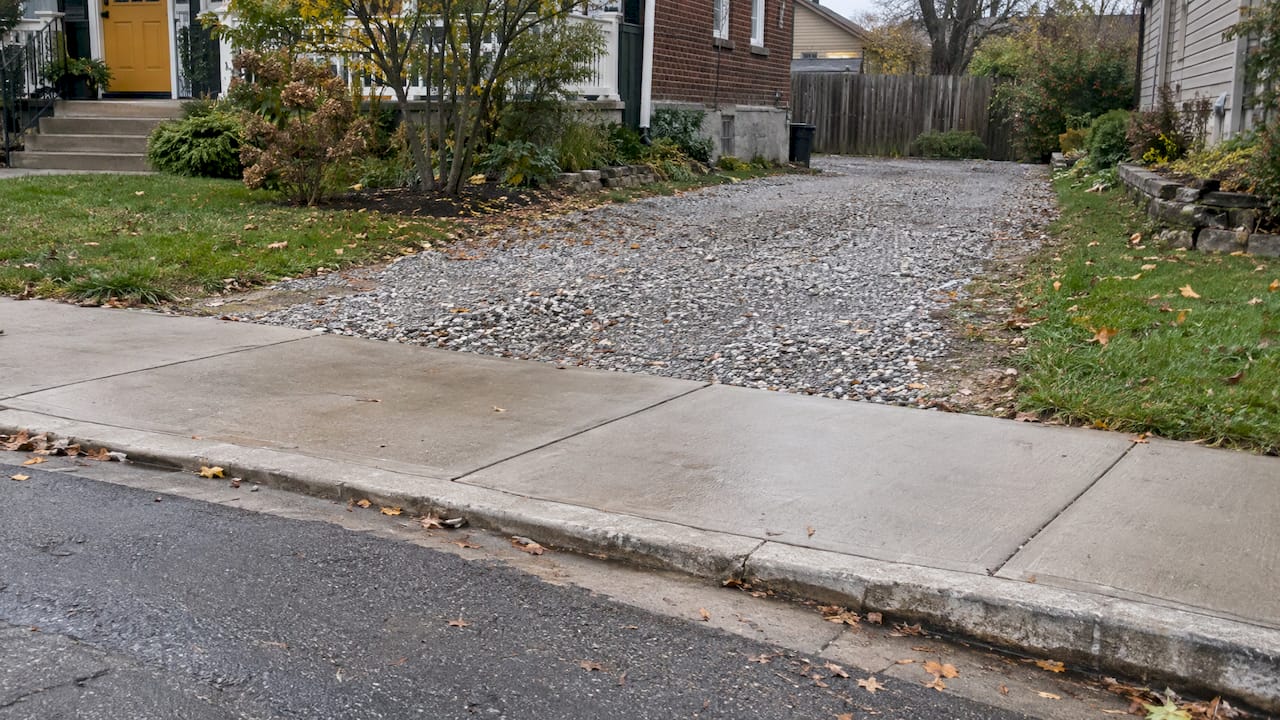
If your new or rebuilt driveway touches the public right-of-way, the strip between your lot and the street that includes the curb, sidewalk and apron, you need a permit in Cincinnati. The City’s Department of Transportation and Engineering (DOTE) lists driveway installation among the work that requires a right-of-way permit. Outside city limits, the Hamilton County Engineer or your township handles it. The permit decides who may do the apron work, what it costs and when you can start. A well-built driveway on your own lot is a separate job, and that is the part we do at Tri-State Brush Control & Gravel.
TL;DR
- Inside Cincinnati, driveway work in the right-of-way needs a Street Opening Permit, and a DOTE-licensed street contractor must do the driveway approach (the apron where the driveway meets the street).
- In unincorporated Hamilton County, the County Engineer issues the permit for driveways that connect to a county road. The application fee is $20.00 and non-refundable.
- Cincinnati’s 2026 fee schedule starts at $55.00 for the administrative fee and $70.00 for a concrete or asphalt driveway street opening, plus per-square-yard charges.
- A driveway permit is not zoning approval. Check with Zoning Administration before you widen a driveway or add parking.
- Call 811 before anyone digs, and settle the permit path before you schedule clearing or base work.
Table of Contents
- First question: which authority is your driveway under?
- What counts as a driveway permit job inside the city
- How to apply for a Cincinnati driveway permit
- What the 2026 permit fees look like
- Driveways outside the city: Hamilton County rules
- Timing the permit around the rest of the job
- Special cases for different readers
- Where our work fits
- Promo: clear the path, then build the driveway
- Perspective
- FAQ
- Sources
First question: which authority is your driveway under?
Cincinnati-area addresses fall under different rule books, and the mailing address often misleads. A “Cincinnati” address can sit in the city, in an unincorporated township or in a village with its own rules.
- City of Cincinnati streets: DOTE issues the permits. Its resource page points driveway applicants to the General Right-of-Way Permit and lists standard drawings C115 through C119 for driveways.
- Unincorporated Hamilton County: The Hamilton County Engineer’s Driveway Rules and Regulations require a permit before any driveway that meets a County road is built or reconstructed.
- Townships and villages: Some run their own process. Delhi Township’s driveway zoning certificate application says a new driveway or expansion may also need a permit from the County Engineer or Township Public Works, depending on the street.
- State routes: Access to a state route is a state matter. Hamilton County’s Access Management Regulations cover county and township roads in unincorporated areas, not state routes or municipal streets.
If you cannot tell where your property line meets the street, DOTE offers a right-of-way setback request through its Permit Center at 513-352-3463. The City does not survey private property, so the request helps you locate the right-of-way line but does not replace a survey.
What counts as a driveway permit job inside the city
Cincinnati treats any disturbance of sod, sidewalk, curb or pavement in the right-of-way as a street opening. That wording matters, because a project that sounds like “just fixing the driveway” can fall under a bigger permit than you expect.
The City’s 2026 Right-of-Way and Street Restoration Manual draws the line this way:
- A Sidewalk/Driveway Repair Permit is issued only to replace a deteriorated concrete walk or driveway that is rebuilt in its original location.
- If the driveway is removed and relocated, you need a Street Opening Permit instead.
- Property owners may do sidewalk work in the right-of-way without a licensed contractor only if the work is under 65 square feet and involves no driveway or drive apron.
So widening, shifting or adding a driveway entrance almost always puts you in Street Opening territory. DOTE’s New Driveway Approach Permit Procedures, updated in February 2025, state that installing or modifying a driveway approach requires a Street Opening Permit and that all approach construction must be done by a DOTE-licensed street contractor.
The free sidewalk repair permit does not stretch to driveways. The City’s sidewalk regulations book says those permits cover only existing sidewalk, are limited to 5 square feet, and are not issued for repairs within a driveway.
How to apply for a Cincinnati driveway permit
Here is the sequence DOTE’s 2025 procedure lays out, with the places it tends to go wrong.
- Check with Zoning Administration first. A DOTE permit is not zoning approval. PropertyPermitGuide’s Ohio driveway overview makes the same point: a right-of-way permit does not authorize expanded parking on the lot. People often get the street permit and then learn the lot layout needs a separate certificate.
- Decide the scope. Same-place replacement, a wider apron and a relocated entrance sit under different permits. Settle this before you collect quotes, because the permit type drives who can do the work.
- Hire a DOTE-licensed street contractor for the approach. The City requires it for driveway and approach construction in the right-of-way. The City’s driveway ordinance adds that the city engineer must approve the driveway layout before construction and before a building permit is issued.
- Prepare a site plan. DOTE asks for a plan showing subsurface utilities, shut-off valves, hydrants, poles, trees, signs, catch basins, curbs, property lines and the nearest intersection. The ordinance also bars a curb cut closer than five feet to municipal facilities such as hydrants, poles, catch basins or crosswalks. Mark those on your plan and measure twice.
- Call Ohio811. DOTE’s procedure has you call to have underground utilities marked. Do this before the plan is final and again before any digging starts.
- Submit, pay and wait for approval. Do not stage equipment on the street frontage until the permit is in hand.
The common failure is sequencing: owners book clearing and base work, then discover the layout needs city approval and the apron needs a licensed street contractor. Moving a driveway entrance mid-project means redoing the plan.
What the 2026 permit fees look like
Cincinnati revised its right-of-way permit fee schedule on January 1, 2026. Two lines matter for most driveway street openings:
| Fee | Base amount | Per additional unit |
|---|---|---|
| Street Opening administrative fee | $55.00 for 2 sq yds or less | $0.25 per additional sq yd |
| Concrete or asphalt driveway street opening | $70.00 standard, 2 sq yds or less | $5.00 per additional sq yd |
Here is a worked example on those figures. Say the opening is 10 square yards. The administrative fee is $55.00 plus 8 × $0.25, or $57.00. The driveway street-opening fee is $70.00 plus 8 × $5.00, or $110.00. If both lines apply, that is $167.00 in permit fees, before any contractor charge. Confirm which lines apply to your job with the DOTE Permit Center, since the final assessment is theirs.
Sidewalk repair permits have their own lines: $30.00 for single-family residential (or $65.00 for all others) for up to 50 linear feet of sidewalk including one driveway, then $10.00 per extra 50 feet and $13.00 to $16.00 per extra driveway depending on width at the street. These rose from the 2024 schedule, which charged $9.00 and $12.00 to $15.00. Fees are revised periodically, so read the live schedule before you budget.
The permit fee is a small share of the total. If you are comparing paving materials as well, a guide on what concrete driveways cost explains why quotes for the same driveway differ so much.
Driveways outside the city: Hamilton County rules
In unincorporated Hamilton County, the Engineer’s rules set a firm routine:
- A permit is required before any driveway intersecting a County road is built or reconstructed.
- The application fee is $20.00 and non-refundable, and you submit duplicate detailed plans.
- A permit is valid for a maximum of one year.
- You give 48 hours’ notice before starting work in the right-of-way. The right-of-way permit application says to call the Engineer’s Office at 513-946-8900 between 7:30 and 9:30 AM.
The permit is also a binding agreement. Accepting it means accepting every printed condition, and it can be revoked for noncompliance, with penalties under Ohio Revised Code sections 5589.10 and 5591.26. For larger access changes, the Access Management Regulations set a $50.00 permit fee including one hour of review plus $35.00 per additional hour. The Engineer’s Office determines whether an application is adequate within 5 working days and completes access-plan review within 15 working days.
Townships add their own layer. Delhi Township says it approves or denies a complete driveway zoning application within 3 to 5 business days, and work must start within 6 months and be substantially complete within 18 months. Other townships set their own timelines, so ask yours.
Timing the permit around the rest of the job
Most driveway projects involve more than the apron. Trees, brush and stumps often stand where the new alignment goes, and the base has to be right before any surface goes down. A workable order looks like this:
- Confirm jurisdiction and permit type.
- Get the layout approved and the apron contractor lined up.
- Clear the path on your own property: brush, saplings, honeysuckle, stumps.
- Build the base and surface on the lot.
- Have the right-of-way work done under the permit and inspected.
Our guide on how to clear land for a driveway walks through the clearing steps and the permit questions that come with them. If you are clearing near a boundary, our notes on property line clearing rules cover what to check first. Larger clearing jobs have their own questions, which we cover in our Ohio land clearing permits guide. If a stump sits in the right-of-way strip, read our stump grinding permit guide before anything gets ground.
Special cases for different readers
Homeowners with a broken gravel driveway. Rebuilding gravel in the same place on your lot is a different question from touching the apron or curb. If any part of the work reaches the sidewalk, curb or street edge, the right-of-way rules above apply to that part. Ask DOTE or your County Engineer’s Office where your property line and right-of-way begin before you schedule.
Developers and builders. The city engineer must approve the driveway layout before a building permit is issued, so the driveway design belongs in your earliest site plan. Pair it with clearing and site prep so the access point is cleared and staked before equipment arrives.
Real estate agents and sellers. Open permits and unpermitted work can surface at sale. If a seller has a driveway change that was never permitted, read up on selling a house with unpermitted work so you know how enforcement and compliance questions tend to arise, then start with the issuing authority.
Landowners with long frontage. Driveways off county roads and state routes follow different rules. Identify the road owner first, since that decides which office issues the permit.
Where our work fits
The permit rules above govern the right-of-way. The driveway on your own lot is a different kind of work, and it is the kind we do every day: clearing the path, then repairing or installing a gravel driveway. Gravel holds up when the base and drainage are right, which is why we wrote a guide on driveway base preparation.
Our forestry mulching method grinds brush and saplings into mulch on site in one pass, so there is no burning and no hauling. That keeps the alignment clear quickly while your permit paperwork moves along.
Promo: clear the path, then build the driveway
If you are planning a driveway in the Cincinnati area, we clear the route and repair or install gravel driveways for residential and commercial properties across the Ohio, Kentucky and Indiana tri-state area. Our instant pricing tool gives you a figure without waiting on a site visit, and we offer flexible financing for larger jobs. See the details on our gravel driveway repair and installation page.
If the driveway needs trees, brush or stumps removed first, our land clearing for construction service prepares the site, and the full list is on our services page.
Perspective
Permits get the attention, but we see the driveway as one project with two zones: the public strip, which the City or County controls, and your lot, which you control. Treating them separately is what keeps a job on schedule.
Our approach is to do the work on your property in a way that does not create problems later. A cleared path with no stumps, a gravel driveway built on a proper base with drainage in mind, and no burn piles or hauled debris. That is why we use one-pass forestry mulching: the vegetation is ground on site into mulch, and the land is ready for the next step.
Our advice is to settle the permit path first, then clear, then build. Get your layout approved, mark the utilities, and only then bring in equipment. A driveway built in the right order is cheaper and lasts longer than one that gets redone to fit a permit.
Yoshua
FAQ
Do I need a permit to repair my existing driveway in Cincinnati?
It depends on where the work happens. Replacing a deteriorated concrete driveway in its original location can fall under a Sidewalk/Driveway Repair Permit, while removing and relocating it requires a Street Opening Permit. Work that stays entirely on your own lot raises zoning questions rather than right-of-way ones, so confirm with Zoning Administration.
Can I pour or lay my own driveway apron?
Not in Cincinnati’s right-of-way. The City’s rules say driveway and approach construction must be done by a DOTE-licensed street contractor, and the owner exemption for sidewalk work under 65 square feet excludes any driveway or apron work.
How long does a driveway permit take?
It varies by authority. Delhi Township states 3 to 5 business days for a complete driveway zoning application. Hamilton County’s access regulations set 5 working days to judge an application complete and 15 working days for access-plan review. Ask DOTE for its current turnaround, and apply before you book any crew.
Does a driveway permit cover widening my driveway for extra parking?
No. DOTE’s driveway permit is about the right-of-way, not zoning. Parking expansion on the lot can need a separate zoning certificate, so check with Zoning Administration before you widen.
Who do I call first?
For city addresses, the DOTE Permit Center at 513-352-3463. For unincorporated Hamilton County, the County Engineer’s Office at 513-946-8900. Call Ohio811 before any digging.
Sources
- DOTE Permits & Licenses, City of Cincinnati
- DOTE Resource Page
- New Driveway Approach Permit Procedures (2025)
- 2026 ROW and Street Restoration Manual
- Sidewalk Regulations Book
- Right-of-Way License and Permit Fees, 2026
- Permit Fee Schedule, 2024
- Cincinnati Municipal Code §721-141
- Hamilton County Engineer, Driveway Rules and Regulations
- Hamilton County Right-of-Way Permit Application
- Hamilton County Access Management Regulations
- Delhi Township driveway zoning certificate application
- PropertyPermitGuide, Ohio driveway permits