
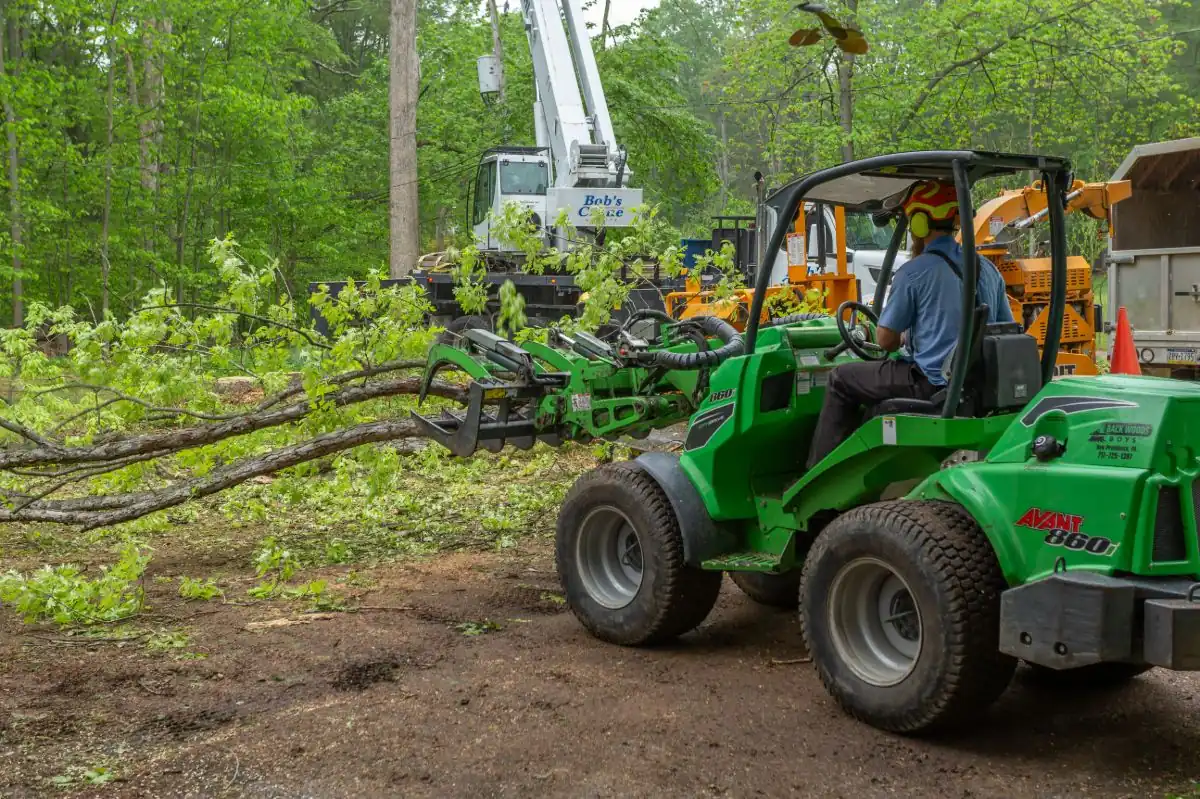
Clearing brush off your own ground usually needs no permit at all. Burning what you cut almost always does, and that is where people get caught. This guide separates the two, sets out the rules for Ohio, Kentucky and Indiana as they are actually written, and tells you which office settles the question for your property.
The short answer
For most private property in this region, mechanical clearing (cutting, mulching or grinding vegetation on land you own) is not something the state permits or licenses. There is no "land clearing permit" issued by Ohio, Kentucky or Indiana as such. What exists instead is a set of separate rules that a clearing job can trip over, and it is worth knowing which one applies to you before a machine arrives.
- Open burning: regulated at state level in all three states, and the single most common thing people get wrong. If you plan to burn what you cut, this is your constraint.
- Local zoning: county or township. Rarely restricts clearing itself, but can govern what you do next: a driveway, a structure, a change of use, or a lot split.
- Water and wetlands: federal and state rules apply if the work touches a stream, wetland or floodplain. This is the one that carries real penalties.
- Tree preservation ordinances: a municipal matter, and mostly a concern inside city limits rather than on rural acreage.
Open burning: the rule most people get wrong
This is where clearing jobs run into trouble. Every state here allows some burning of vegetation, none of them allow burning of construction or demolition debris, and all three impose seasonal or distance limits that catch people out. The rules differ by state, so start with the one you are standing in.
Ohio
Two separate rules stack. Under Ohio Revised Code 1503.18, open burning is prohibited in unincorporated areas during March, April, May, October and November between 6am and 6pm, the spring and autumn wildfire seasons. Separately, Ohio Administrative Code 3745-19 splits the state into restricted and unrestricted areas.
A "restricted area" means inside any municipal corporation, plus a buffer outside it: 1,000 feet for a municipality of 1,000 to 10,000 people, and one mile for a municipality over 10,000. Inside a restricted area, burning requires written permission from Ohio EPA in advance (OAC 3745-19-03). Outside one, land clearing waste generated on the premises may be burned under OAC 3745-19-04, provided the fire sits at least 1,000 feet from any inhabited building not on the property, atmospheric conditions will carry the smoke away, and the smoke creates no visibility hazard on a road or airfield.
That 1,000-foot setback is what rules burning out on most suburban and small rural lots around Cincinnati, well before anyone reaches the seasonal restriction.
Kentucky
Kentucky works on fire hazard seasons under KRS 149.400. During the spring season (15 February to 30 April) and the autumn season (1 October to 15 December), burning anything within 150 feet of woodland or brushland is illegal between 6am and 6pm, so burning is a before-6pm-and-after-6am problem rather than a blanket ban.
Open burning generally is governed by 401 KAR 63:005 and enforced by the Division for Air Quality. Only natural growth (leaves, trees and limbs) may be burned; construction and demolition debris, including scrap lumber, may not. Burning for land clearing tied to residential, commercial or industrial development is capped at two contiguous acres at any one time.
Indiana
Indiana regulates burning under 326 IAC 4-1, administered by IDEM’s Office of Air Quality. Only vegetation may be burned, never household trash, plastics, building materials, demolition debris or treated wood. Vegetation from a farm, orchard, nursery, tree farm or drainage ditch may be burned for maintenance purposes where the burn takes place in an unincorporated area. Burning that does not fall inside an exemption needs IDEM approval in advance.
IDEM is explicit that its rules are a floor, not a ceiling: city and county restrictions apply in addition to the state ones, so a burn that is legal under 326 IAC 4-1 can still be prohibited locally.
Which rules apply where we work
We work across 18 counties in three states, and the framework that governs your job is set by which state you are in. The table below gives the burning rule that applies in each, and where to settle the zoning question. Zoning in particular is not always a county matter: in much of rural Ohio the township holds zoning authority rather than the county, and any municipality can add rules of its own inside its limits.
| County | State | Open-burning framework | Confirm local zoning with |
|---|---|---|---|
| Hamilton | OH | ORC 1503.18 + OAC 3745-19 | Township zoning, or the municipality if inside city limits |
| Butler | OH | ORC 1503.18 + OAC 3745-19 | Township zoning, or the municipality if inside city limits |
| Clermont | OH | ORC 1503.18 + OAC 3745-19 | Township zoning, or the municipality if inside city limits |
| Warren | OH | ORC 1503.18 + OAC 3745-19 | Township zoning, or the municipality if inside city limits |
| Montgomery | OH | ORC 1503.18 + OAC 3745-19 | Township zoning, or the municipality if inside city limits |
| Preble | OH | ORC 1503.18 + OAC 3745-19 | Township zoning, or the municipality if inside city limits |
| Boone | KY | KRS 149.400 + 401 KAR 63:005 | County planning & zoning, or the city if inside city limits |
| Kenton | KY | KRS 149.400 + 401 KAR 63:005 | County planning & zoning, or the city if inside city limits |
| Campbell | KY | KRS 149.400 + 401 KAR 63:005 | County planning & zoning, or the city if inside city limits |
| Dearborn | IN | 326 IAC 4-1 (IDEM) | County plan commission, plus any city ordinance |
| Franklin | IN | 326 IAC 4-1 (IDEM) | County plan commission, plus any city ordinance |
| Ripley | IN | 326 IAC 4-1 (IDEM) | County plan commission, plus any city ordinance |
| Switzerland | IN | 326 IAC 4-1 (IDEM) | County plan commission, plus any city ordinance |
| Ohio | IN | 326 IAC 4-1 (IDEM) | County plan commission, plus any city ordinance |
| Fayette | IN | 326 IAC 4-1 (IDEM) | County plan commission, plus any city ordinance |
| Rush | IN | 326 IAC 4-1 (IDEM) | County plan commission, plus any city ordinance |
| Decatur | IN | 326 IAC 4-1 (IDEM) | County plan commission, plus any city ordinance |
| Union | IN | 326 IAC 4-1 (IDEM) | County plan commission, plus any city ordinance |
This table gives the state framework that governs each county, not a substitute for a local call. Townships, cities and fire districts add their own restrictions on top, and those vary within a single county. Confirm before any burn, and before any clearing tied to a build, a driveway or a lot split.
Wetlands, waterways and floodplain
This is the category where getting it wrong is genuinely expensive, and it is the one people least expect to apply to a brush job. If clearing involves placing fill or dredged material into a stream, wetland or other water of the United States, Section 404 of the federal Clean Water Act applies and the US Army Corps of Engineers is the permitting authority. State water quality certification sits alongside it, and Ohio separately permits work in isolated wetlands.
Cutting vegetation is not the same as filling, and routine brush clearing well away from water is usually outside all of this. The risk sits in the details: grading, stream crossings, culverts, pond work, or driving heavy equipment through a wet swale can all change the analysis. Floodplain regulations are administered locally and add another layer near any mapped watercourse.
- If the work touches a stream bank, a pond edge, a wet area that holds water into summer, or a mapped floodplain, ask before you start rather than after.
- Riparian setback ordinances exist in a number of communities across this region and are set locally, not by the state.
- A pre-work walk of the property is the cheapest way to find these. We flag them during the free estimate when we see them.
What we handle for you
On a typical clearing job on private ground, the honest answer is that there is nothing to file. Mechanical clearing of brush, saplings and overgrowth on your own property, with the material mulched in place, sits outside the burning rules entirely and outside zoning in almost every case.
Where a job does raise one of the questions above (a burn you want to do anyway, work near a creek, clearing ahead of a build), we will tell you which office to call before we start rather than after. We do not file permits on your behalf, and any contractor who tells you a permit question is nothing to worry about is worth a second look.