
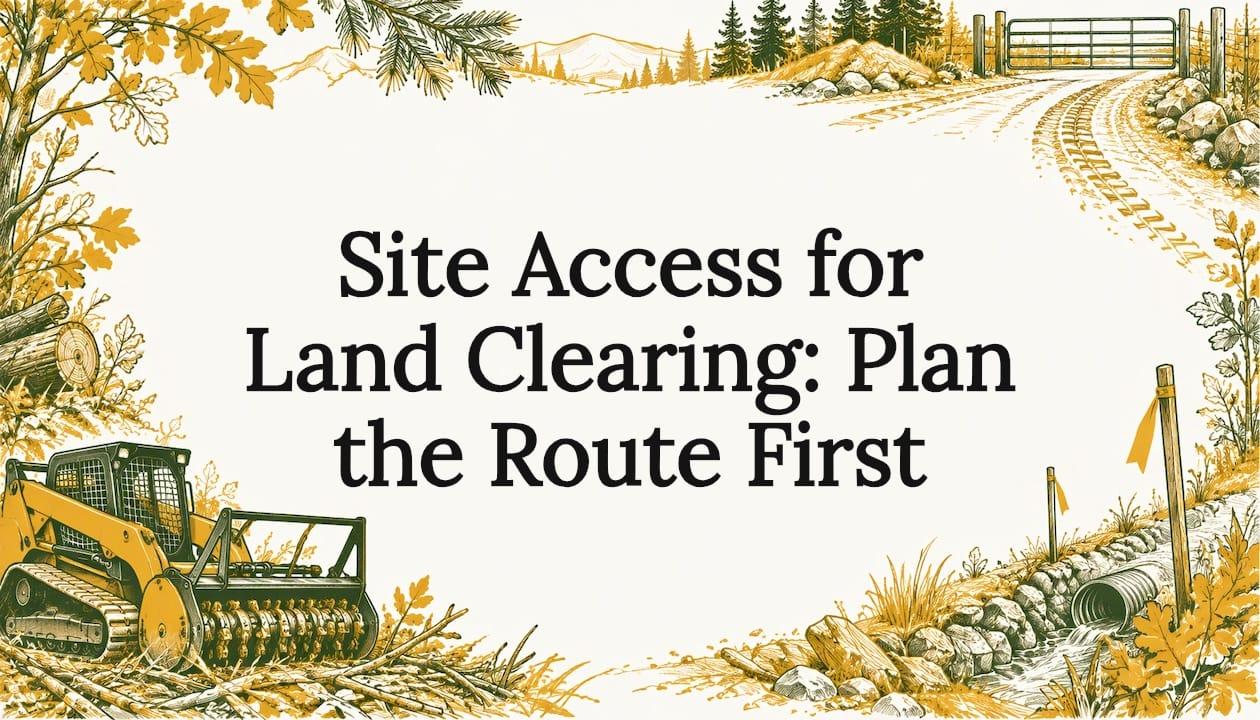
Site access for land clearing means the route, entrance and working space that let machines, crews and trucks reach the ground you want cleared, and leave it again without damaging anything. Settle it before the first tree comes down, because gate width, soft ground, buried lines and a shared lane decide the schedule more often than the vegetation does. We run forestry mulching, lot clearing and gravel driveway work across the Cincinnati area, and the jobs that go smoothly are the ones where the path in was planned first. Our land clearing for construction service starts from that principle.
TL;DR
- Access is the first land-disturbing step: define one entrance, one travel lane and one staging area before any clearing starts.
- Measure the narrowest point on the route (gate posts, bridges, low limbs) and check that machines and trucks can get in, turn and get out.
- Request an 811 locate at least two working days ahead in Ohio and Kentucky, and mark private lines such as septic, wells and irrigation yourself.
- Protect what stays: tag retained trees, fence their roots, and keep equipment and stockpiles out of those zones.
- A stable, well-drained entrance keeps mud off the road, and it can double as the base of your future gravel driveway.
Table of Contents
- What site access covers, and how it differs from site prep
- Walk the route before you pick equipment
- Locate utilities before anything moves
- Permits and rules that touch the access route
- Build an entrance that stays put
- Drainage and erosion: plan where water goes
- Protect the trees and features that stay
- Access for specific jobs
- Common access problems and how to prevent them
- Where we come in
- Our perspective
- FAQ
- Sources
What site access covers, and how it differs from site prep
Site preparation is the whole job of making land ready: clearing, grading, drainage, utilities. Site access is the narrow first slice of it. It answers three questions: how does equipment get onto the property, where does it travel once there, and where do trucks, fuel and tools stay while work happens?
The North Carolina Department of Environmental Quality's site preparation chapter says construction access is normally the first land-disturbing activity on a site. Mississippi's erosion manual likewise requires access points, construction routes and equipment parking to be defined, with access pads installed before land is disturbed. Those are other states' manuals, but the logic travels: whatever you build first gets driven on by everything that follows.

For a homeowner with an overgrown backyard, this can be as simple as a side gate and a strip of lawn. For a developer, it is a designed entrance, a haul route and a staging pad. The planning steps are the same.
Walk the route before you pick equipment
The most common access failures are physical, and a walk-through catches nearly all of them. Industry guidance on lot clearing lists wet areas, buried utilities, mature trees, steep grades, rock and restricted access as the conditions that turn a one-day estimate into a delay. Walk the property from the road to the farthest corner you want cleared and note each of these:
- Narrowest point. Measure gate openings between posts, not between the open gates. Check culverts and small bridges for load limits, and look up for low limbs and wires.
- Turning room. Trucks that haul in equipment need a place to unload and turn. Backing out onto a county road is slow and unsafe.
- Ground condition. Low spots, seeps and springs turn into ruts after one rain. In the Ohio Valley, spring and late winter are the wet months, so a route that is firm in August may not be in March.
- Slope. Steep side hills limit where a machine can work safely and where water will run once the vegetation is gone.
- Neighbors. If the best route crosses another parcel, get permission in writing before the job is scheduled, not on the morning of.
Take photos and a rough sketch with measurements. That is what lets a contractor quote accurately from a distance, and it is the information our instant pricing tool rewards you for having ready.
Why machine size matters
A compact machine can reach places a large one cannot, but a bigger machine clears dense growth faster. Our one-pass forestry mulching grinds brush and small trees into mulch where they stand, so no burning and no hauling of waste out through your gate. That removes the dump-truck traffic that usually makes access hardest on tight residential lots. You still need a way in for the mulcher itself, which is why the measurements above come first.
Locate utilities before anything moves
This is the step that is legally required, not just wise. In Ohio, the person excavating must notify OHIO811 at least two working days before digging, not counting the day of the call or weekends and holidays, and no more than 16 calendar days ahead. Call 811 or submit a request online. Utilities then mark their lines and respond.
Kentucky works the same way across the river: excavators, including property owners working on their own land, must contact Kentucky 811 at least two working days before excavation, and the rule applies to work with mechanized equipment or within a utility easement. Indiana has its own 811 program, so check its notice period if your parcel is on that side of the tri-state area.
Three practical points:
- 811 does not mark private lines. Septic tanks and fields, well lines, irrigation, invisible pet fences and a lateral to a detached garage are yours to identify. Flag them before the crew arrives.
- Overhead lines count. Note the lowest wire or limb along the route, because it caps the machine height.
- If marks are missing. OSHA's trenching guidance says that where utility owners cannot respond within 24 hours (or longer if state or local law requires) or cannot establish exact locations, work may proceed with caution using detection equipment or other acceptable means. Do not treat that as a shortcut: in Ohio and Kentucky the two-working-day notice comes first.
OSHA's pre-bid checklist for excavation work is a useful template even on a small job: it lists traffic, nearby structures, soil, surface and ground water, and overhead and underground utilities as things to assess before work starts.
Permits and rules that touch the access route
Clearing the vegetation is one question. Creating or changing an entrance is another, and it is regulated separately.
- Driveway and right-of-way permits. If your route meets a public road, many road authorities require a permit before you build or change a driveway. Michigan's Tuscola County Road Commission, for example, requires permits before any construction within the right-of-way, including modifying an existing driveway. Gloucester County, New Jersey, requires an access permit even for a temporary driveway. Rules differ by county and township, so ask the road authority that owns the road in front of your property.
- Land-disturbance and stormwater permits. Larger jobs trigger them. Greeley, Colorado, for example, requires a permit for clearing, grading and excavation of one acre or more, or less if part of a larger plan. Ohio thresholds are different, which is why we keep a county-by-county Ohio land clearing permit guide.
- Streams and wetlands. If the route crosses a creek, ditch or wetland, federal and state approvals may apply. New York's standards note that altering protected waterbodies needs state approval and that Army Corps of Engineers approval may be required under the Rivers and Harbors Act and the Clean Water Act. Ask your county or the Corps district before routing a machine through water.
For developers, buffers and setbacks can also change where the route may go. Our guide to the 50 foot buffer walks through preparing land without fines.
Build an entrance that stays put
A temporary construction entrance does two jobs: it carries heavy machines without rutting, and it stops mud from reaching the street. The North Carolina manual specifies temporary entrances with a 12-foot minimum width per lane, geotextile fabric under non-synthetic surfaces, and at least 6 inches of aggregate or mulch, positioned to limit sediment leaving the site. Treat those figures as a sound benchmark; your local rules may set different ones.

The Federal Highway Administration adds a driveway-specific point: surfaces should be paved or stabilized so material does not wash onto the road, with crowning, ditching and culverts to keep surface water from running onto the pavement.
Turn the temporary route into the permanent driveway
On many lots the construction entrance and the future gravel driveway share a path. Building it once, with a stable base and shaped to shed water, saves tearing it up later. If your existing gravel drive is rutted, washed out or sinking, it will fail again under heavy equipment, so repairing it before clearing starts protects the work. Our gravel driveway repair and installation crews handle both, and our guide on clearing land for a driveway covers steps, permits and costs in detail.
Drainage and erosion: plan where water goes
Once ground cover is gone, rain moves soil. The North Carolina manual notes that removing surface ground cover leaves a site vulnerable to accelerated erosion, so good planning keeps clearing to what is needed and puts the access route in first. New York's guidance adds that diverting offsite runoff away from exposed soil is the most economical and effective erosion control, with stabilized channels leading to a stable outlet.
For your route, that means:
- Crown or slope the entrance so water leaves the surface instead of running down the ruts.
- Keep the lane out of natural drainage paths and low swales where you can.
- Leave a vegetated strip along roads and streams until the last stage.
- Plan the first weeks after clearing: see our guide to erosion control after clearing.
Mulching helps here. Because mulch is left on the ground where the vegetation stood, the soil is covered immediately rather than bare.
Protect the trees and features that stay
Access planning is also how you keep the things you want. Connecticut's 2023 erosion guidance says retained trees should be visibly tagged and trees to be removed marked with an X, with fencing at least 3 feet high around protection zones of retained trees within 40 feet of a proposed building or excavation, and no heavy equipment travel or stockpiles inside those zones.
On your property, that translates into a simple routine:
- Walk the lot with the crew and tag every tree, shrub or stone wall that stays.
- Mark the travel lane with flags or paint so operators do not wander.
- Fence the root zones of valuable trees, and set the staging area well outside them.
- Agree where each stockpile or mulch pile goes.
If habitat matters on your land, our guide to wildlife-friendly land clearing explains timing and layout, and after the work, replanting restores cover.
Access for specific jobs
Clearing for a survey. Surveyors need a walkable line to corners and boundaries before anything else. A narrow pass cleared along property lines is often enough; see how to clear land for a survey.
Selling a property. Real estate agents and sellers usually want the front approach, the driveway and the first visible stretch of yard in order. Start with the entrance: a clear way in lets buyers and photographers see the lot.
Invasive brush, such as honeysuckle. Dense thickets often block their own access. The first pass opens a lane, and from there the crew works outward. Our honeysuckle removal work is done this way.
Commercial and development sites. Delivery trucks, inspectors and multiple trades share the route, so traffic flow matters. A written traffic control plan, such as the kind described in this traffic control plan for paving, shows how to separate vehicles and keep a work zone safe.
Common access problems and how to prevent them
| Problem | What it causes | Prevention |
|---|---|---|
| Gate or lane too narrow | Wrong machine, return trip | Measure the narrowest point, including posts and overhead limbs |
| Soft ground | Ruts, stuck equipment | Schedule around wet seasons, stabilize the lane |
| Unmarked private lines | Damaged septic, well or irrigation | Flag them before arrival; request 811 for public lines |
| Route across a neighbor's land | Mid-job stoppage | Written permission in advance |
| No turnaround or staging area | Slow loading, blocked road | Define them on the sketch |
| Mud on the road | Complaints, possible citations | Stabilized entrance with proper stone |
Most of these are one-hour fixes before the work and one-day delays after it starts.
Where we come in
We clear land and repair gravel drives for homeowners, landowners, developers and agents across the Ohio-Kentucky-Indiana tri-state area, and we take jobs of any size. Our forestry mulching handles vegetation in one pass, on site, with no burning and no hauling of waste. Most jobs finish promptly without multiple crews, and flexible financing is available for larger projects.
If you have your gate measurements, photos and a sketch of the route, you are ready for a price. Use our instant pricing calculator for a first figure, or see everything we do on our services page.
Our perspective
Every land clearing job we do begins at the same place: where the machine comes in. Owners ask us about acres and species, but the plan that keeps a job quick is the route.
We favor forestry mulching because it keeps the work on your land. Vegetation is ground into mulch in one pass, so there is no burn pile to permit, no line of trucks hauling debris through your gate, and no extra crew to coordinate. That makes access simpler for you and gentler on the soil.
We also like to treat the driveway as part of the clearing plan. A solid gravel entrance carries equipment today and your vehicles tomorrow, so we repair or install it as part of the same project when the site calls for it.
Walk the lot, measure the gate, call 811, tag what stays. Then call us with those details and we can price the job fast.
Yoshua
FAQ
How wide does an access route need to be for land clearing equipment?
It depends on the machine, so measure your narrowest point and give that number to the contractor. As a benchmark for construction entrances, North Carolina's manual specifies at least 12 feet per lane. Residential gates are often narrower, which is why a quote should come with measurements.
Do I have to call 811 if I am only clearing brush?
In Ohio and Kentucky, the notice rule applies to excavation, and Kentucky's applies to work with mechanized equipment on private property or within a utility easement. Grinding stumps or regrading a driveway can disturb the ground, so request a locate at least two working days ahead and confirm with 811 if you are unsure.
Do I need a permit to build or change an entrance onto a public road?
Often yes. Road authorities commonly require a permit before you build or alter a driveway that meets a public road, and the rules vary by county and township. Ask the agency that maintains the road, and see our Ohio permit guide for Ohio counties.
Can my existing gravel driveway be used as the access route?
Yes, if it is firm, drains well and is wide enough for the equipment. A driveway with ruts, washouts or soft spots is better repaired first so heavy machines do not make it worse. We repair and install gravel driveways as part of clearing projects.
What should I send a contractor to get an accurate price?
Send the address, photos of the route and the area to be cleared, the narrowest gate or lane measurement, and a note on any private lines, wet spots or neighbors' land you must cross. Those details let the contractor choose equipment and quote the job without surprises.
Sources
- OSHA: Trenching and Excavation Safety
- North Carolina DEQ: Chapter 6.0 Site Preparation
- Mississippi DEQ: Construction Phasing/Sequencing
- FHWA: Access Management (Driveways)
- NYSDEC: Erosion and Sediment Control Standards
- Connecticut DEEP: Erosion and Sediment Control Guidelines
- Gloucester County, NJ: Roadway Access and Opening Permits
- Tuscola County Road Commission: Permit Standards
- City of Greeley: Land Grading Permit Requirements
- OHIO811: Homeowners
- LG&E and KU: Digging safety
- How to Plan a Lot Clearing Project Without Delays