
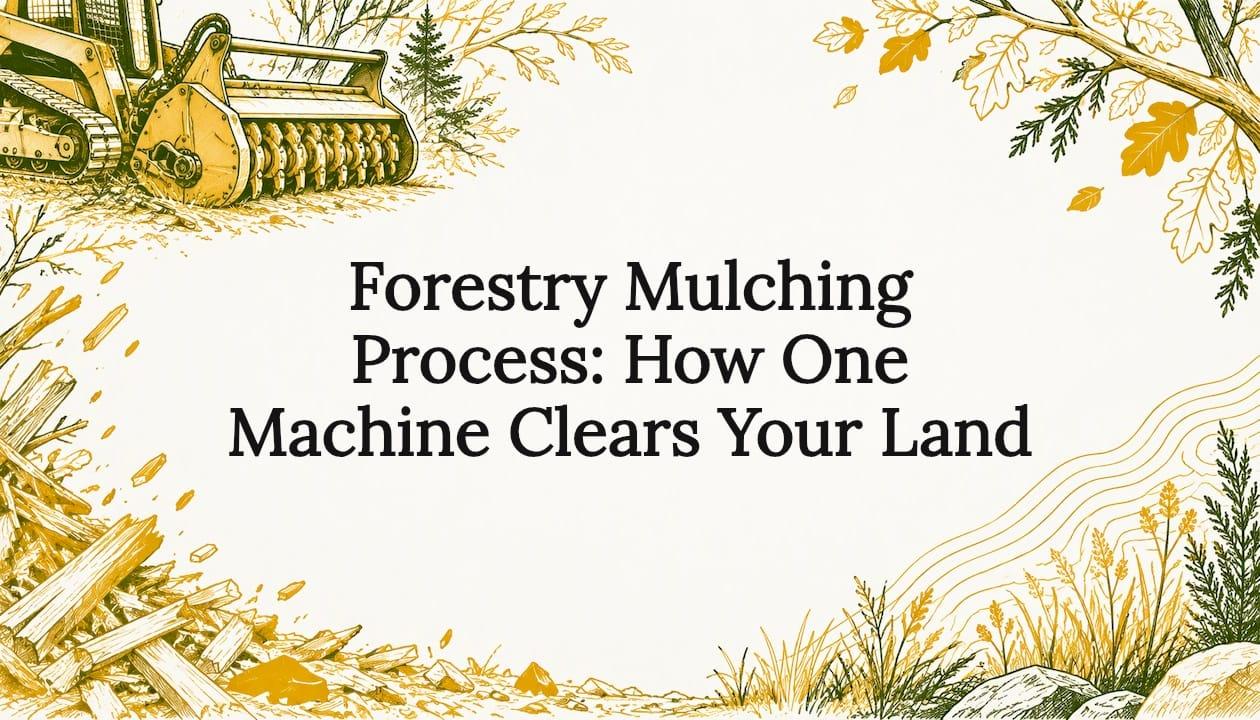
Forestry mulching clears overgrown land in one pass: a single machine with a rotating cutting head cuts, shreds and spreads brush, saplings and small trees as mulch right where they stand. Nothing is burned and nothing is hauled away. For a homeowner with a wall of briars, a developer with a lot to prep or a seller who needs a property to show well, that means fewer crews, fewer trucks and a shorter timeline. At Tri-State Brush Control & Gravel we run this process across the Ohio-Kentucky-Indiana tri-state area, and this guide walks through it start to finish so you know what you are buying.
TL;DR
- Forestry mulching uses one machine to cut and grind vegetation into a mulch layer left on site, so there is no burning and no hauling.
- An acre can take anywhere from one to eight hours, depending on vegetation, terrain, soil and how clean you want the finish.
- Cost climbs with stem size and density: light brush is the low end, mature trees over 6 to 8 inches are the high end.
- The mulch layer protects soil, but the finish you want (lawn, pasture, building pad) decides what happens next.
- Our instant pricing calculator gives you a number before anyone visits.
Table of Contents
- What forestry mulching actually is
- The forestry mulching process, step by step
- How long does it take?
- What it costs, and what moves the price
- Benefits worth knowing
- Which reader is it for?
- What to do after the mulcher leaves
- Is forestry mulching worth it?
- Perspective
- Ready to clear your land
- FAQ
- Sources
What forestry mulching actually is
The Texas A&M Forest Service defines mulching as using machinery to cut, break and shred larger woody vegetation into small pieces that are spread over the site. Traditional clearing is a chain of separate jobs: fell, cut up, pile, burn or haul, then regrade the scars. Mulching collapses that chain into one operation.
The machine is a carrier (a skid steer, excavator, tractor or dozer) fitted with a mulching head. The USDA Forest Service equipment catalog lists these carriers and notes that the head size matters: vertical-shaft heads generally handle material up to 6 to 8 inches, while horizontal-shaft heads can take larger stems. The Tallgrass Prairie Center's roadside vegetation manual adds that forestry heads can cut and mulch trees up to 15 inches in diameter and mulch smaller trees up to 8 inches.
What is left behind is a layer of chipped wood and shredded brush, with roots still in the ground. That is the point: the roots keep holding soil while they decay, instead of being torn out the way they would be with a bulldozer.

The forestry mulching process, step by step
1. Walk the site and set the goal
Everything starts with what you want the land to look like afterward. A backyard that needs to become lawn is a different job from a lot that needs a clean pad for construction or a fence line that needs a clear corridor. The Virginia Department of Conservation and Recreation advises landowners to define site goals and build a plan with short- and long-term targets and a budget. Mark property lines, tell us which trees stay, and point out hazards such as buried utilities, old fencing, wells, septic fields and drainage ditches.
Where it goes wrong: skipping the boundary conversation. A mulcher does not know which sapling is the neighbor's or which tree you wanted for shade. Decide before the head spins.
You can start the pricing side right away. Our land clearing cost calculator gives instant pricing, and larger jobs can be financed.
2. Prepare the ground and pick the equipment
Mulching is forgiving about site prep. You do not need to fell trees or stack brush first. The Texas A&M Forest Service lists the real limits: sites with large rocks or debris that cannot be mulched, excessive slopes or extreme wetness may not suit machine mulching. The USDA catalog adds that rocky ground wears teeth faster and uneven ground makes head control difficult.
Slope changes the machine choice. According to the same catalog, excavator-mounted mulchers can work slopes steeper than 30 percent and compact the soil less because the excavator does not drive over everything it mulches, though the narrower head means more passes.
Your prep list is short:
- Flag anything that must stay: specimen trees, survey pins, utility markers.
- Move vehicles, firewood, play equipment and loose debris out of the work area.
- Tell the crew about old foundations, buried wire, wells or tanks.
- Check that the equipment can reach the work area from the road.
3. Work the perimeter first, then the interior
The Texas A&M Forest Service recommends starting along the perimeter and then working along the land's contour to reduce erosion, with 10 to 15 percent overlap between passes. Starting at the edge also sets a clean boundary and keeps the machine from pushing material toward what you want to protect.
The operator then moves through the interior, feeding standing brush and small trees into the head. Travel speed is a function of density: the same agency puts typical mulching at two to four miles per hour, slowing to one to two mph in thick brush and rising to three to four mph in light grasses.
This is where the one-pass method earns its keep. Cutting, grinding and spreading happen in the same motion, which is why we can complete most jobs promptly without bringing in multiple crews.
4. Take the second look: stumps and the finishing pass
A final shredding pass at a low height, the Texas agency suggests two to four inches, evens out the surface and chops anything left standing. Mulching heads grind a wide range of stump sizes, according to Virginia Tech's land clearing guide, but a stump you want gone completely, for instance where a building or driveway will sit, is a separate task. We handle that with stump grinding so you can have it done in the same visit.
5. Walk the finished site
Do not judge the result by one average number. Colorado State University's forest restoration group warns that deep patches of mulch can suppress plant growth, and that average depth alone is often not enough to judge a project. They suggest looking at five things: how the mulch is distributed, the maximum depth, the largest patch, the largest piece and the average depth.
In plain terms, walk the site and check for thick piles, big chunks and bare patches against what you planned in step 1. Tell the crew before they leave and any spots can be touched up.
How long does it take?
Virginia Tech's guide says an acre can take one to eight hours, depending on vegetation, site size, soil, terrain and how clean the owner wants the finish. A 2026 cost guide from the Green Industry Report puts light brush and saplings under about 4 inches at 2.5 to 5 machine hours per acre, thick brush with trees to 6 to 8 inches at 5 to 8 hours, and trees to 10 to 12 inches at 10 to 16 hours with a dedicated machine.
So a quarter-acre backyard of honeysuckle and briars is often a short job, while a wooded five-acre parcel is a multi-day project. Every one of those hours is time you do not spend waiting on a burn permit or a hauling schedule.
What it costs, and what moves the price
Prices vary with density, stem size, terrain and distance. For reference, the Green Industry Report's 2026 figures for 1 to 5 acre jobs on flat, accessible ground run $420 to $1,500 per acre for light brush, $840 to $2,400 for thick brush with trees to 6 to 8 inches, and $3,490 to $6,400 for mulching trees to 10 to 12 inches. Those figures exclude mobilization (moving the machine to your site), permits, erosion control and stump grinding.

Older research shows why mulching is attractive. A Virginia Tech study cited in the same guide found mulching cost $850 per acre versus $1,650 for conventional clearing. Hauling and burning are costs you never incur.
Factors that raise the price:
- Trees over 6 to 8 inches in diameter, which need larger equipment.
- Steep or wet ground, which slows the machine.
- Rocks, old wire or debris in the brush.
- Small acreage with a high minimum for moving equipment.
Our forestry mulching cost guide goes deeper on the numbers, and the calculator turns your lot into a figure without waiting for a callback.
Benefits worth knowing
The Texas A&M Forest Service notes that because the mulch is produced on site, there are no costs beyond labor and machine rental, and the layer reduces erosion, stabilizes soil, returns nutrients, improves moisture retention and evens out soil temperature swings. It also carries a low risk of introducing non-native species, since the material never leaves the site.
Virginia Tech adds that mulching helps maintain or increase soil organic matter and can prepare sites for pasture. Compared with a bulldozer, Oklahoma State University Extension points out that mulching leaves roots in the soil and often keeps native grass in place, as summarized in this comparison of clearing methods. For a fuller list see our forestry mulching benefits page.
Which reader is it for?
Different owners use the same process differently.
- Homeowners with an overgrown yard: mulching turns a thicket into usable ground in a day or two, and the finish can be lawn, garden or open woods.
- Developers and builders: a cleared lot is ready for survey and grading. See our land clearing for construction service.
- Real estate agents and sellers: cleared sightlines and a tidy lot change how a property shows. The one-pass method keeps the schedule short.
- Landowners fighting invasives: mulching removes the top growth of species like honeysuckle fast. Controlling them for good takes a plan, since the Virginia DCR guide notes invasive plant management takes years of treatment and monitoring. Mississippi State Extension notes mulching rarely gives long-lasting control on its own, so we pair clearing with a follow-up plan for resprouting species.
What to do after the mulcher leaves
The mulch layer is a finish for some goals and a starting point for others. If you want grass, the extension guidance is consistent. Fresh wood chips have a high carbon-to-nitrogen ratio and borrow nitrogen from the soil as they break down, so mixing them in can reduce fertility for a while; an Ask Extension answer citing Purdue says ideally chips compost in place for a year.
For seeding, another Ask Extension answer recommends clearing out remaining chips, testing the soil, loosening the top 4 to 6 inches and mixing in about three inches of compost, raking seed into the top quarter inch, covering it with straw and keeping it moist until it germinates. For turf, a soil test should confirm pH between 6.0 and 7.2, according to this extension answer.
If the plan is a building pad, driveway or foundation, tell us at the start, because roots and chips in the soil matter there. Our aftercare guide covers each finish.
Is forestry mulching worth it?
It is when you want vegetation gone quickly, the stems are mostly under 6 to 8 inches, and you want to avoid burning, hauling and soil disturbance. It saves the most on thick brush, overgrown fence lines, right-of-way corridors and lots with a mix of saplings and invasives. For a single large tree or a piece of ground that needs deep excavation, a different tool fits, and we will tell you which at the estimate.
The USDA Forest Service says mulching is used as an alternative to chemical treatment of competitive species and for aesthetic treatments and right-of-way maintenance, which are the same jobs our local customers bring us.
Perspective
We built our work around one idea: clearing land should be one trip, not five. A mulcher that cuts, grinds and spreads in the same pass means no burn pile, no dump trucks and no second crew arriving a week later.
The questions we hear most are about the end result. Do you want lawn, woods, a building pad or a clear fence line? Answer that first and the rest follows: where we start, how low we take the finish and what you do about stumps and regrowth.
We also think pricing should not be a mystery. That is why we offer instant pricing and flexible financing, so a larger job does not have to wait. Whether it is a few overgrown acres in Cincinnati or a lot across the river in Kentucky or over the line in Indiana, our goal is the same: land you can use, finished promptly.
Yoshua
Ready to clear your land
We handle forestry mulching, brush removal, honeysuckle removal, stump grinding, fence line and right-of-way clearing and small demolition for homes and commercial properties across the Ohio-Kentucky-Indiana tri-state area, with instant pricing and flexible financing. Start with the forestry mulching service page or see everything we do on our services page.
If you also have a rutted or washed-out driveway, we repair and install gravel driveways too, so the whole property can be finished in one project.
FAQ
Will grass grow after forestry mulching?
Yes, with the right prep. A thick mulch layer can hold back grass seedlings until it breaks down, so most owners rake off excess chips, test the soil, loosen it and then seed. Mixing clover into the seed helps, since clover fixes nitrogen for young grass, per Ask Extension.
How long does it take a forestry mulcher to clear an acre?
Between one and eight hours, depending on vegetation, terrain, soil and the finish you want. Light brush sits at the quick end and dense stands with larger trees at the long end.
What can a forestry mulcher not handle?
Very large trees need bigger equipment, and sites with large rocks, extreme wetness or steep slopes may call for a different machine setup. Tell us about the terrain when you request a price and we will match the equipment to it.
Does forestry mulching remove stumps?
The head grinds stumps down to the surface, and stumps that must come out fully, such as under a slab or driveway, are handled with stump grinding as part of the same job.
Do I need to remove brush before the crew arrives?
No. Mulching needs no felling, cutting or hauling by you. Just clear out vehicles and loose items and flag what has to stay.
Sources
- Mulching and Shredding, Texas A&M Forest Service
- Forest Operations Equipment Catalog: Mulchers, USDA Forest Service
- Mechanical Methods for Brush Control, Tallgrass Prairie Center
- Options for Clearing Land to Establish Pasture, Virginia Tech
- Land Clearing Cost per Acre, Green Industry Report
- The Private Landowners Guide to Invasive Plant Management, Virginia DCR
- Mechanical Site Preparation for Forestry in Mississippi, Mississippi State Extension
- Mulching: A knowledge summary and guidelines, Colorado State University
- Forestry Mulching Benefits vs Traditional Land Clearing
- When to plant grass where tree was removed, Ask Extension
- Growing grass where a tree has been removed, Ask Extension
- Chipped tree stumps in the soil, Ask Extension