
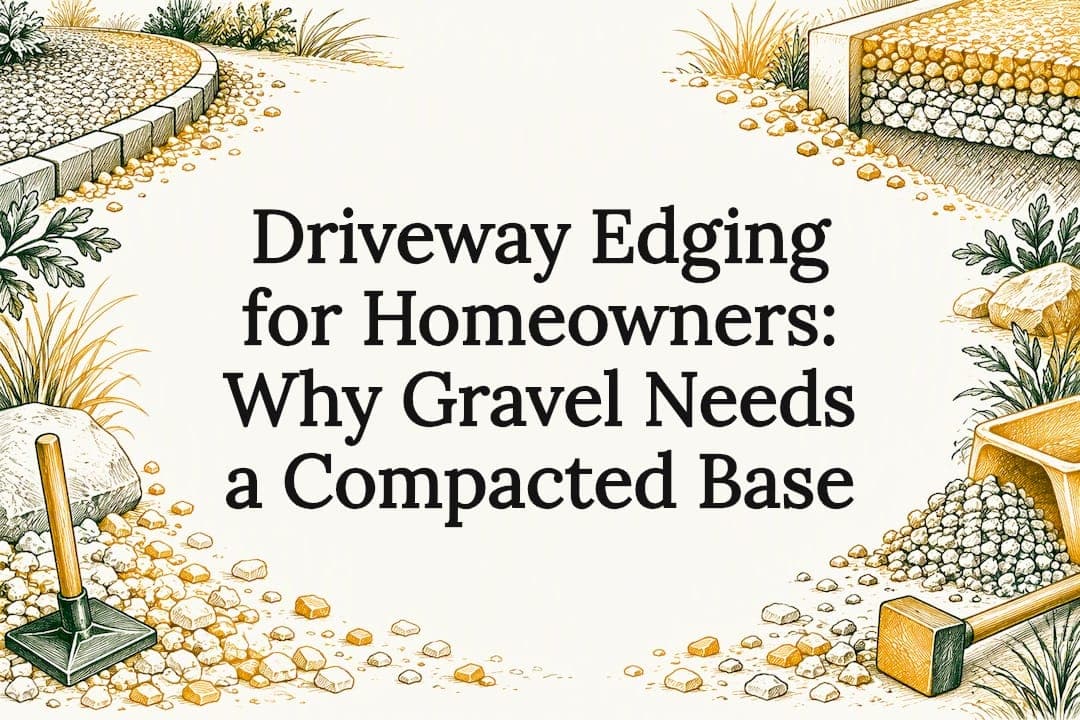
Concrete curbing and properly anchored metal edging give the strongest structural containment for driveways carrying vehicle traffic, while stone, brick, and paver borders deliver the best decorative payoff once that structure is in place. A simple gravel strip looks tidy but holds nothing back. If you have a gravel driveway, edge restraint set on a correctly compacted base is not optional, it is what keeps your stone from spreading into the lawn.
TL;DR:
- Build the restraint in an 8 to 12 inch trench over 4 to 6 inches of compacted angular stone, then anchor it into the base.
- Installed metal edging costs $3 to $10 per linear foot, compared with $20 to $40 for Belgian block and $8 to $15 for concrete curbing.
- A 60 foot perimeter costs $480 to $900 for metal or extruded concrete, while Belgian block costs $1,200 to $2,400.
- Require contractor quotes to specify trench depth, base material and compaction, anchoring, drainage, cleanup, and warranty coverage for settling or restraint failure.
- In cold climates, set masonry borders on a concrete footing 4 to 6 inches deep with frost protection, and inspect metal stakes each spring.
Table of Contents
- Material options for driveway edging: what each one does best
- Installation essentials and structural rules every homeowner must follow
- Costs, budgeting examples, and how to compare contractor quotes
- Maintenance, durability, and climate considerations
- Practitioner perspective: gravel driveways and when to call a pro
- Build the structure first, then choose your style
- How we can help with your gravel driveway edging project
- FAQ
- Sources
Material options for driveway edging: what each one does best
Picking the right material starts with knowing what it's actually built to resist. Some options hold back lateral force under tires; others just mark a line.
Poured or extruded concrete curbing is the workhorse for structural containment. It resists lateral push from vehicle weight, handles snowplow contact reasonably well, and lasts decades with minimal upkeep. Installed cost runs about $8 to $15 per linear foot, and it needs a formed trench with consistent depth to cure straight.
Metal edging, usually steel or aluminum, is the thin, modern option. It disappears visually, which suits minimalist or contemporary homes, and it's one of the more affordable structural choices at roughly $3 to $10 per linear foot installed. It only works if the stakes anchor deep enough to resist shifting.
Belgian block and natural stone bring old-world weight and texture, the kind that suits a traditional brick or stone-front home. They cost more, typically $20 to $40 per linear foot installed, reflecting the labor of setting individual units on a stable footing.
Paver borders split the difference: decorative pattern options with real structural capacity when the pavers are anchored into a compacted base and locked with edge restraint methods trusted by homeowners. Left loose, they creep and gap within a season or two.
Gravel or rock borders are purely decorative. They define a planting bed nicely but provide no lateral resistance, so they're the wrong choice anywhere a tire might roll close to the line.
Plastic and composite edging is the budget option for garden beds and light-duty paths. It bends easily, installs fast, and has no business containing a driveway surface that sees daily vehicle loads.
Matching material to style matters as much as matching it to function:
- Stone and Belgian block pair naturally with traditional or colonial-style homes.
- Metal edging suits modern, minimalist, or industrial exteriors where a thin clean line reads better than bulk.
- Concrete curbing is neutral enough to work with nearly any architectural style, which is part of why it remains the default structural choice.
Installation essentials and structural rules every homeowner must follow
Edging fails for one of two reasons: it sits too shallow, or it isn't anchored against the base. Both are fixable with the right sequence.
- Excavate the trench 8 to 12 inches deep. This depth is what lets the restraint sit below the compacted sub-base rather than floating on top of loose soil, which is where structural edging for gravel driveways starts.
- Compact 4 to 6 inches of angular crushed stone as the sub-base. Angular stone interlocks under pressure, unlike rounded pea gravel, which tends to roll and scatter instead of locking in place under vehicle traffic.
- Set the edge restraint before adding surface gravel, securing it with stakes driven through a separation membrane into the compacted base below.
- Anchor metal edging with stakes spaced tightly enough to resist the sideways push of tires; loose stakes are the most common cause of metal edging drifting out of line.
- Pour concrete curbing on a formed trench with consistent depth so it cures as one continuous structural piece rather than cracking at inconsistent pour lines.
- Set paver borders into bedding sand over the compacted base, then lock them with an edge restraint rated for vehicle loads, not a lightweight landscape version.
- Plan tie-ins where the driveway meets asphalt, concrete, or a paver field so the transition doesn't create a lip that traps water or catches a tire edge.
Pro Tip: Ask any contractor bidding your project to state the trench depth and sub-base thickness in writing. A vague "we'll prep it properly" line in a quote is where corners get cut.
A driveway edge is closer to a structural abutment than a garden border. Even a small shift in the restraint lets the compacted base move, and once that happens the surface above it follows.

Costs, budgeting examples, and how to compare contractor quotes
Material price is only part of the number. Excavation, base depth, and compaction determine whether the edge holds up, and those line items should show up in every bid you compare.

Using the installed cost bands above, a 60-foot perimeter (roughly what wraps a two-car driveway on one side and the front) runs about $480 to $900 for metal edging, $480 to $900 for extruded concrete, or $1,200 to $2,400 for Belgian block, all figures drawn from the per-linear-foot ranges cited above. A 24-foot side strip for a gravel driveway extension costs within a range consistent with typical metal edging per-foot pricing. For a deeper look at base-depth formulas and what drives gravel driveway installation costs overall, see our budget gravel driveway cost breakdown.
Before you sign anything, check that the quote lists:
- Excavation depth and trench width for the edge restraint.
- Sub-base material and compaction method, not just "base included."
- Edge restraint type and anchoring method (stakes, spikes, or concrete footing).
- Drainage provisions at the edge, including any grading or outlet.
- Cleanup and haul-off of excavated soil.
- Warranty terms covering settling or restraint failure.
A quote missing these items is the clearest sign of a low bid built on skipped prep rather than efficiency. If a number looks noticeably lower than competing bids, ask specifically what depth and base material it assumes.
Maintenance, durability, and climate considerations
Edging material determines how much upkeep you'll do and how long it lasts before replacement. Concrete curbing needs the least attention, mostly checking for cracks after freeze-thaw cycles. Metal edging needs occasional rust inspection on steel versions, though aluminum avoids that issue entirely. Paver borders need joint sand topped up every couple of years as it washes out. Plastic and composite edging degrades fastest under UV exposure and repeated freeze-thaw movement.
Winter conditions add stress that summer installation doesn't test. Deicing salts can damage nearby plants and some hardscape surfaces, so edging placed near planting beds benefits from salt-tolerant species or a buffer zone. Freeze-thaw heaving is the bigger structural risk: masonry borders set in cold climates should sit on a concrete footing roughly 4 to 6 inches deep with frost-protection detailing, the same footing depth cited for Belgian block and natural stone installations.
- Sweep gravel and paver edges seasonally to prevent buildup that traps moisture against the restraint.
- Check metal edging stakes each spring for frost heave that may have loosened anchoring.
- Grade the driveway surface slightly away from edges to avoid the "bathtub effect," where water pools inside a rigid border instead of draining off.
For short-term fixes between seasons, our guide on drainage-first maintenance steps covers what you can handle yourself.
Practitioner perspective: gravel driveways and when to call a pro
Working gravel driveways across the tri-state area, we see the same failure pattern repeatedly: stone migrates into the yard within a season because the edge restraint was skipped or set too shallow. A 5,000-pound vehicle puts real lateral force on that edge, and without a restraint anchored below the compacted base, the stone has nowhere to go but out.
Trenching to the correct depth, compacting an angular stone base, and tying the restraint into that base is equipment-intensive work. It's a reasonable DIY project for a short decorative strip, but a full driveway perimeter on a vehicle-rated base is where professional compaction equipment earns its cost.
We use forestry mulching to clear site vegetation without burning or hauling waste, which can be beneficial when a gravel driveway project also requires tree line or brush clearing before base work starts. We offer pricing estimates and handle jobs of various sizes.
Build the structure first, then choose your style
If there's one thing homeowners get backward, it's sequencing: they pick the prettiest edging material before confirming the base underneath can support it. Structure first, decoration second. A driveway with daily vehicle traffic needs a properly anchored restraint before anyone should spend money on Belgian block or a decorative pattern.
Once the trench depth and base compaction are right, almost any material on top will perform as advertised. Skip that step, and even premium stone edging loosens within a year or two. If you'd rather hand the excavation and compaction work to a contractor, that's a reasonable call for anything beyond a short garden strip.
— Yoshua
How we can help with your gravel driveway edging project
We provide gravel driveway repair and installation services, including site prep, base compaction, and drainage work to help ensure edging holds up long term.
- Gravel driveway repair and installation for new builds or fixing a driveway that's already shifting.
- Site prep and brush or tree line clearing ahead of excavation, using our one-pass forestry mulching method.
- Compaction and drainage grading to keep your new edge restraint doing its job through freeze-thaw seasons.
To get instant pricing, have a few photos, your driveway's approximate length, and the current surface type ready. We offer flexible financing and take on projects of any size. Get your instant price estimate today.
FAQ
What is the cheapest way to edge a driveway?
Metal edging is typically the most affordable structural option, running about $3 to $10 per linear foot installed. Plastic or composite edging costs less up front but isn't rated for vehicle loads, so it suits garden beds rather than a driveway perimeter.
What is the best edging for a driveway?
The best choice depends on your driveway surface and traffic load: concrete curbing and properly anchored metal edging offer the strongest lateral containment, while paver borders and Belgian block add structural support plus decorative appeal. For gravel driveways specifically, edge restraint set below a compacted sub-base is essential to stop stone migration.
What are some good ideas for driveway edging?
Popular combinations pair a structural base, like metal edging or concrete curbing, with a decorative surface treatment such as stone accents or a paver border pattern. Matching material to home style works well too: stone and Belgian block for traditional exteriors, clean metal lines for modern ones.
What is the 3 inch edging rule?
This isn't a standard industry measurement; for driveways specifically, the more relevant guidance is a trench depth of 8 to 12 inches with a 4 to 6 inch compacted sub-base beneath the edge restraint. Definitions of smaller edging rules vary by landscaping context and don't apply to vehicle-rated driveway borders.
Sources
- Enhance Curb Appeal: Best Driveway Edging Ideas and Techniques
- How to install a gravel driveway (step by step)
- Driveway edging ideas: materials, cost & how to choose
- Paver driveway extension cost guide - Concrete estimator hub