
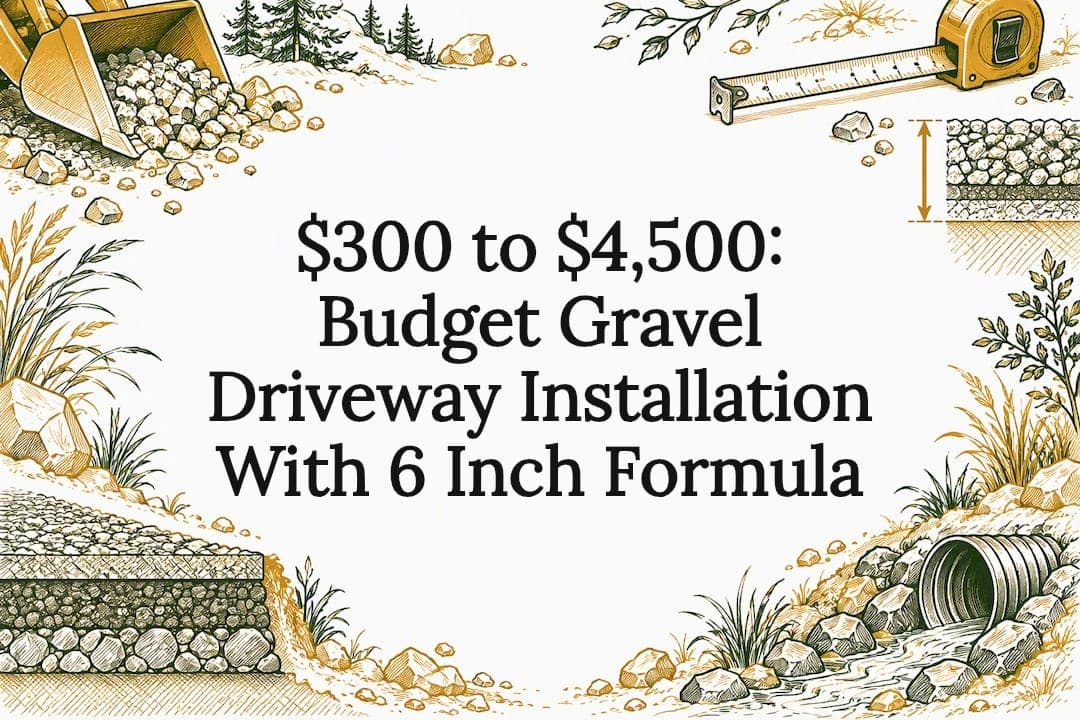
Expect to pay somewhere in the range of $300 to $4,500 for a gravel driveway, with many homeowners landing near a commonly cited average of about $1,500. A rough per-square-foot rule of $1 to $3 covers most projects, but the final number moves with driveway size, gravel depth, and how much site prep the ground needs before any stone gets delivered.
TL;DR:
- The total cost for a gravel driveway varies from $300 to $4,500, depending on size, site prep, and gravel depth, with the average around $1,500.
- Gravel prices typically range from $1 to $3 per square foot, but actual expense depends on regional delivery costs, gravel type, and project specifics.
- Proper site preparation, including subgrade stabilization and installation of geotextile fabric, is crucial to prevent early failure and reduce long-term repair costs.
- DIY installation can cut labor costs by 40 to 60 percent, but only for flat, well-drained sites with minimal slope or drainage issues.
- Local labor rates and permit requirements significantly impact the final price, with higher regional wages and drainage regulations increasing overall costs.
Table of Contents
- Average costs and typical price ranges: what the headline numbers mean
- Cost estimator by size: worked examples and quick formula
- Gravel types, per-ton pricing, and how to pick base vs top course
- Site preparation, structural layering, drainage, and common extra line items
- Pro installation vs DIY: labor, equipment, timing, and cost tradeoffs
- How regional labor costs shape your total price
- Permits and local regulations that affect your budget
- How long a gravel driveway lasts and what shortens its life
- How Tri-State Brush Control & Gravel approaches driveway installs
- Getting an instant price or site assessment
- Primary sources and further reading
- Sources
- FAQ
Average costs and typical price ranges: what the headline numbers mean
The headline figures sound simple, but they hide a lot of variation. A short single-car driveway with decent existing grading can land at the low end of that $300 to $4,500 range, while a long rural driveway needing excavation and drainage work pushes toward the top.
Most 2026 cost guides put the national average near $1,500, with typical projects falling somewhere between $300 and $4,500 depending on length, width, and extras. Per-square-foot pricing usually runs $1 to $3, though material-only costs by the ton follow a separate band that depends on stone type and delivery distance.
A gravel driveway typically runs $1 to $3 per square foot, a range wide enough to account for depth, stone grade, and regional delivery costs.
A quote that looks like a bargain often just skips items that show up later as change orders. Here's what a typical price usually includes and what it tends to leave out:
- Included: delivered gravel, spreading, and basic compaction of the top layer.
- Included: minor grading to shed water away from the surface.
- Excluded: excavation of old material or soft subgrade.
- Excluded: geotextile fabric, edging, and culvert work.
- Excluded: permits or drainage fixes for problem sites.
Reading a quote line by line before signing avoids the most common source of budget overruns on this kind of project.
Cost estimator by size: worked examples and quick formula
The math behind a gravel driveway is straightforward once you know the formula: multiply area by depth to get cubic yards, convert to tons, then multiply by your local per-ton price. A widely used residential layer design calls for about 4 inches of base stone plus 2 inches of top course, for a 6-inch total depth.
- Measure length times width to get square footage.
- Multiply square footage by depth in feet (6 inches equals 0.5 feet) to get cubic feet, then divide by 27 for cubic yards.
- Multiply cubic yards by roughly 1.4 to 1.5 (the typical weight factor for crushed stone) to estimate tons.
- Multiply tons by your local delivered price per ton for a materials estimate, then add labor and extras.
The figures below are illustrative math based on a 6-inch total depth and a stated cost-per-ton assumption. Treat them as a worked example, not a market quote, since your local delivered price will differ.
Small orders often carry a delivery or short-load surcharge, so ordering a full truckload, or combining a small job with a neighbor's order, tends to bring the per-ton price down.
Gravel types, per-ton pricing, and how to pick base vs top course
Not every gray rock does the same job. Base material needs to lock together under load, while top course needs to drain and look presentable underfoot and under tires.
- Crusher run or ABC stone works as the base layer because its mix of fines and larger fragments compacts into a stable foundation.
- CA6 or 21AA are regional names for similar dense-graded base blends used the same way.
- #57 stone is a common top-course choice, with clean angular pieces that drain well and resist rutting.
- Recycled concrete can substitute for virgin base stone at a lower cost when it meets grading requirements.
- Pea gravel and river rock are decorative options that cost more and need more frequent top-ups because their rounded shape does not lock together as tightly.
Material choice affects both upfront cost and long-term maintenance, since a driveway topped with loose decorative stone typically needs regrading and replenishment more often than one finished with angular crushed stone.
Regional quarry proximity matters more than the stone type itself. Delivery distance for heavy material often has a bigger effect on your final per-ton price than the difference between comparable base stones.
Site preparation, structural layering, drainage, and common extra line items
A gravel driveway is a small pavement structure, not just a pile of rock. Transportation engineering guidance for gravel roads treats the driveway as a system of layers: a prepared subgrade, a compacted granular subbase, and a wearing surface on top, and the Gravel Roads Construction and Maintenance Guide notes that proper grading and compaction at each stage are what keep a gravel surface stable over time.

Skipping subgrade prep is the single biggest reason gravel driveways fail early, developing ruts, potholes, and soft spots within a season or two. A common residential specification calls for roughly 4 inches of compacted base plus 2 inches of top course, a 6-inch total depth that balances cost against durability.
Beyond the stone itself, several line items commonly show up on contractor quotes:
- Excavation of topsoil or unsuitable subgrade before new material goes down.
- Geotextile fabric placed between subgrade and base to stop soil from mixing into the stone.
- Edging with steel, plastic, or timber to keep gravel from spreading into lawns.
- Culverts where the driveway crosses a drainage ditch or low spot.
- Grading and crowning to shed rainwater to the sides instead of pooling in the middle.
Pro tip: Geotextile fabric and a properly crowned surface are cheap compared with the cost of hauling in fresh gravel every year or two to replace stone that sank into soft subgrade.
Pro installation vs DIY: labor, equipment, timing, and cost tradeoffs
Hiring a contractor buys you equipment, experience reading subgrade conditions, and a warranty on the work. A typical professional quote covers excavation, base and top material, delivery, spreading, and compaction as one package.
Doing it yourself can cut costs, but only if the ground cooperates and the work is done correctly.
- Renting an excavator or skid steer for grading typically runs into real daily costs on top of fuel and transport.
- A plate compactor rental adds another line item, and skipping it is the fastest way to end up with a driveway that ruts within months.
- DIY projects can save on labor, but that savings gets erased quickly if poor compaction or a missing subbase forces a redo.
DIY installs can save roughly 40 to 60% on labor costs, though that figure assumes the subgrade work and compaction are done to the same standard a contractor would use.
The math favors DIY mainly on small, flat, well-drained sites. Anything with slope, soft soil, or drainage complications tends to favor a professional crew with the right equipment on hand.
How regional labor costs shape your total price
Material prices vary by region, but labor is often the bigger swing factor in a final quote. Areas with higher construction wages and busier contractor schedules tend to price driveway jobs higher per square foot, even when the gravel itself costs about the same.
Labor-heavy tasks, excavation, grading, culvert installation, and compaction, are priced locally based on equipment operator rates and how much competition exists among contractors in the area. A market with few land-clearing and grading crews can see quotes run higher simply because demand outstrips available equipment and labor.
Seasonal demand plays into this too. Contractors in busy regions often book out weeks in advance during peak building season, and rushed scheduling can add a premium. Off-season timing, generally late fall through winter in most climates, tends to soften both labor and material pricing as crews look to fill their schedules.
Getting more than one quote from local contractors remains the most reliable way to see how regional labor rates are actually affecting your project, since national averages only tell part of the story for any specific address.
Permits and local regulations that affect your budget
Whether you need a permit for a gravel driveway depends entirely on your local jurisdiction, and the rules vary widely from one municipality to another. Some areas require a permit only when the driveway connects to a public road or affects drainage into a right-of-way; others have no permit requirement for a simple residential resurfacing project.
Culvert installation and changes to how water drains toward a street or ditch are the details most likely to trigger a permit requirement, since local governments care about stormwater flow more than the gravel itself. Homeowners' associations can add another layer of rules, sometimes dictating stone color, driveway width, or edging requirements independent of any municipal permit.
Checking with your local building or public works department before work starts is the only reliable way to confirm what applies to your address. A contractor familiar with your area can often flag this quickly, but the responsibility for pulling the correct permit typically falls on the property owner or their hired contractor, not on assumption.
How long a gravel driveway lasts and what shortens its life
A well-built gravel driveway can last many years with periodic maintenance, but the range is wide because durability depends more on construction quality than on the gravel itself. The Gravel Roads Construction and Maintenance Guide ties long-term performance to well-graded aggregate with controlled fines, generally in the range of 10 to 14% passing the number 200 sieve, which allows the stone to interlock tightly during compaction.
Poor subgrade prep is the factor that shortens lifespan the most. Water that pools instead of draining softens the base beneath the stone, leading to ruts and potholes that reappear no matter how much fresh gravel gets added on top.

Traffic load matters too. A driveway sized for one car sees far less wear than one handling delivery trucks or heavy equipment regularly, and thicker base layers extend service life under heavier use. Routine maintenance, regrading low spots and topping up thin areas, spaces out the bigger regrading and material replacement projects that eventually come due on any gravel surface.
How Tri-State Brush Control & Gravel approaches driveway installs
Beyond gravel driveway repair and installation, Tri-State Brush Control & Gravel handles the land clearing that often needs to happen first, using a one-pass forestry mulching method to clear overgrown edges without burning or hauling debris. Homeowners can budget larger jobs before committing with available pricing and financing options. For a reliable quote, have your driveway's rough dimensions, a few photos, and notes on any standing water or drainage issues ready to share.
— Yoshua
Getting an instant price or site assessment
If your driveway project also involves overgrown brush, a stump in the way, or a lot that needs clearing before gravel goes down, Tri-State Brush Control & Gravel's service pages cover the related work in one place. Their gravel driveway repair and installation page outlines what a site visit typically involves.
To get a fast estimate, have the following ready:
- Approximate driveway length and width.
- A few photos of the current surface and surrounding grade.
- Notes on any drainage problems, culverts, or slope issues.
You can start with the instant pricing tool for a quick ballpark, or request a full site assessment for a firmer number before work begins.
Primary sources and further reading
- Gravel Roads Construction and Maintenance Guide: layer design, compaction, and aggregate grading guidance.
- Section 6F-1 Pavement Subbase Design and Construction: recycled aggregate as a subbase option.
Sources
- Gravel Roads Construction and Maintenance Guide
- Section 6F-1 - Pavement Subbase Design and Construction
FAQ
Is a gravel driveway cheaper than concrete?
Gravel driveways generally cost less upfront than concrete, since they skip the forms, rebar, and curing time that concrete work requires. The tradeoff is more frequent maintenance, since gravel needs periodic regrading and top-ups that a concrete surface does not.
What are the downsides of having a gravel driveway?
Gravel scatters over time, migrates into lawns, and can rut or pothole if the subgrade was not compacted properly. It also needs occasional regrading and fresh material, and snow removal is trickier since plows and shovels can drag loose stone away with the snow.
Does a gravel driveway increase property value?
A well-maintained gravel driveway can support a property's curb appeal and functionality, particularly in rural or semi-rural areas where gravel is the local norm. A driveway showing ruts, potholes, or thin coverage tends to detract from value rather than add to it, so upkeep matters more than the material choice itself.
How much would 20 feet by 400 feet for a gravel driveway cost?
Using a 6-inch total depth, a 20-foot by 400 foot driveway requires a large amount of stone. At an illustrative per-ton price, that works out to several thousands in material cost alone, before labor, excavation, or extras like culverts and edging are added.