
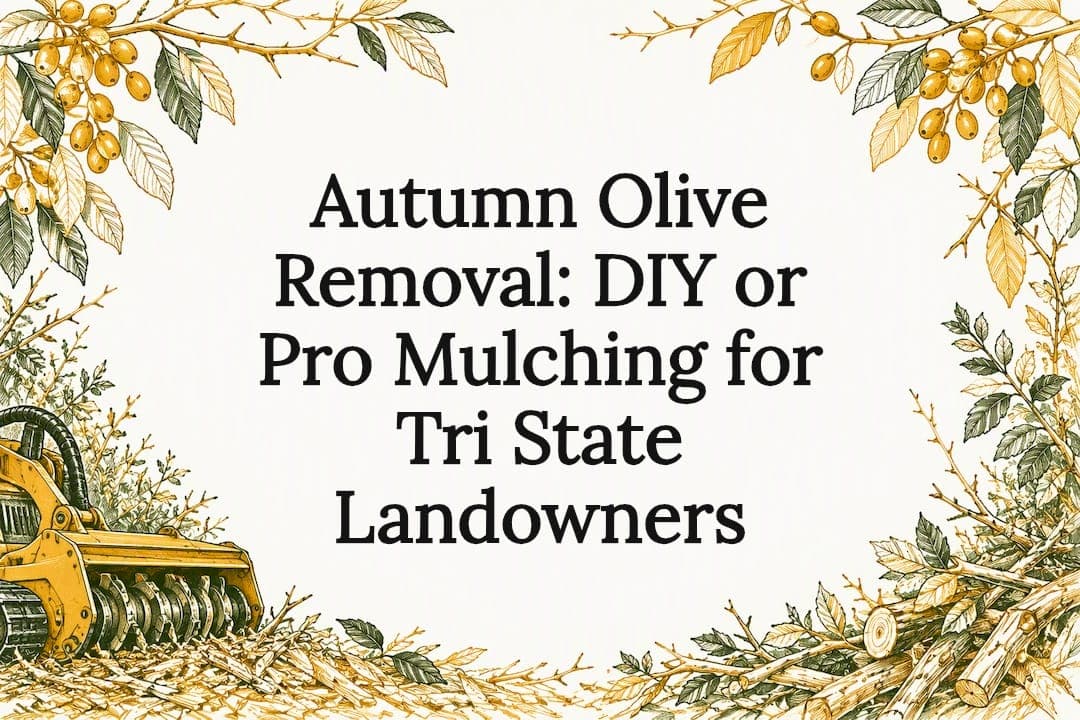
The fastest reliable way to control autumn olive is to combine cutting or mechanical removal with targeted herbicide applied to cut stumps or basal bark, then follow up for two to four years. Small seedlings can be hand-pulled when soil is moist. Dense thickets, steep terrain, or large stems over a few inches wide usually call for professional mechanical clearing. Always read and follow herbicide label directions, and wear proper protective gear.
TL;DR:
- Pull seedlings only when soil is moist, remove the entire root crown, and switch to machinery or herbicide for stems wider than about 3.5 inches.
- For scattered mature shrubs, apply herbicide to fresh cut stumps within minutes, covering the outer 20% of each face; missed stems can resprout.
- Basal bark treatment suits isolated stems near grasses, using roughly 25% triclopyr ester in basal oil on the lower 12 to 15 inches.
- Mechanical mulching clears dense thickets in one pass, but roots resprout, so treat new growth the following season and monitor for two to four years.
Table of Contents
- Methods at a Glance: Quick Comparison of Removal Options
- Hand Pulling and Manual Digging: How to Remove Small Seedlings and Saplings
- Mechanical Removal and Forestry Mulching: Reclaiming Dense Stands
- Cut-Stump Treatment: Step-by-Step Herbicide Protocol for Stumps and Large Stems
- Basal Bark Treatment: Oil-Based Triclopyr Mixes for Selective Stem Control
- Foliar Spray and Resprout Management: Treating Stands and New Growth
- Timing, Monitoring, and a Realistic Multi-Year Plan
- Disposal, Seed Control, and Hygiene to Prevent Reinfestation
- Revegetation: Natives to Plant and Simple Restoration Steps
- Legal Regulations or Permits Required for Invasive Species Removal in the Tri-State Area
- How Professional Forestry Mulching and Contracting Fits Into a Homeowner's Plan
- Hire Tri-State Brush Control & Gravel for Large or Hazardous Autumn Olive Jobs
- FAQ
- Sources
Methods at a Glance: Quick Comparison of Removal Options
Picking the right method depends on plant size, density, and how close the stand is to desirable trees or water.
- Hand pulling: best for seedlings and saplings with a base under about 3.5 inches, done after rain when soil is loose.
- Mechanical or forestry mulching: best for dense, overgrown stands too large or risky to clear by hand.
- Cut-stump plus herbicide: best for scattered mature shrubs where you want a one-time kill without resprouting.
- Basal bark treatment: best for isolated stems in areas where you want to protect surrounding grasses.
- Foliar spray: best for thick patches of young growth with little desirable vegetation nearby.
DIY tools handle small jobs well, but thickets covering a quarter acre or more usually move faster and safer with a contractor, especially from late summer through fall when herbicide uptake improves.
Hand Pulling and Manual Digging: How to Remove Small Seedlings and Saplings
Pulling works only on young plants, and timing matters as much as technique. Soil loosened by rain releases the root crown far more easily than dry, compacted ground, according to Ohio State extension, which notes that hand pulling works best right after rainfall and that the entire root crown must come out to prevent regrowth.
- Water the ground or wait for rain so the soil loosens around the base.
- Grip the stem low, near the root crown, and rock it side to side while pulling upward.
- Use a weed wrench, Root Talon, or Extractigator for stems too thick to pull by hand.
- Shake excess soil from the roots and set the plant aside for drying or disposal.
- Walk the site again in a few weeks to catch missed root fragments that resprout.
Do not attempt to hand-pull anything with a base wider than roughly 3.5 inches. Larger roots resprout readily and are better handled with machinery and herbicide. Wear gloves and eye protection, since autumn olive stems carry sharp thorns.
Pro Tip: Pull in a slow, steady lean rather than a quick yank. A sudden jerk snaps the stem and leaves the root crown behind to resprout.

Mechanical Removal and Forestry Mulching: Reclaiming Dense Stands
Once a stand gets too thick or too established for hand tools, mechanical options take over. Bush-hogging knocks down top growth quickly but leaves roots intact and ready to resprout within a season. Skid-steer mulching grinds stems and brush into mulch on contact, clearing dense thickets in a single pass without burn piles or hauling. Bulldozer clearing works for extreme overgrowth or when the ground also needs grading, though it disturbs more soil than mulching.
- Bush-hogging: fast and cheap for open fields, but regrowth returns within months.
- Skid-steer forestry mulching: turns brush into mulch on-site in one pass, ideal for thickets of mixed size.
- Bulldozer clearing: suited to severe overgrowth combined with grading or site prep needs.
One-pass forestry mulching grinds standing autumn olive into a layer of mulch that stays on the property, which skips the burn pile and the dump run entirely. Mechanical mastication alone tends to stimulate resprouting unless it's followed by herbicide or repeated mowing, according to Montana's invasive species program, so plan on treating resprouts the following season rather than expecting a single pass to finish the job.
Cut-Stump Treatment: Step-by-Step Herbicide Protocol for Stumps and Large Stems
Cut-stump treatment is the standard choice for scattered mature shrubs you want to eliminate in one visit. The technique relies on cutting low and getting herbicide onto the fresh wound before the plant seals it off.
- Cut the stem as close to ground level as possible with a saw or loppers.
- Apply herbicide to the cut face within minutes, while the wood is still wet and the cambium is exposed.
- Cover at least the outer 20 percent of the stump face, which is where the living cambium sits and where uptake happens.
- Repeat on every stem in a multi-trunk shrub, since missed stumps resprout.
- Mark treated stumps so you can check them during follow-up visits.
Extensions commonly recommend a 20 to 50% glyphosate solution or a roughly 25% triclopyr mix for cut-stump applications, with basal bark work using a similar triclopyr-in-oil ratio, according to Penn State Extension. Late summer through fall tends to improve translocation into the root system compared with spring cuts, when sap is moving outward rather than down.
Glyphosate and triclopyr are both effective active ingredients for autumn olive control, but concentrations and carrier oils vary by product label, so check the specific formulation before mixing. Large properties, steep slopes, or sites near water often call for a licensed applicator, both for legal compliance and for safer handling of concentrated herbicide. Avoid spraying on windy days or right before rain, which can carry chemical onto desirable plants or wash it off the stump before it's absorbed.
Basal Bark Treatment: Oil-Based Triclopyr Mixes for Selective Stem Control
Basal bark treatment skips the saw entirely and works directly on standing stems, which makes it a good fit where you want to protect grasses or groundcover growing right up against the shrub.
- Mix roughly 25% triclopyr ester in basal oil, a ratio used in Illinois DNR control guidance for thin-line basal applications.
- Spray or paint the mixture on the lower 12 to 15 inches of the stem, coating the bark fully around the base.
- Reserve this method for isolated stems rather than dense thickets, where coverage gets inconsistent.
- Apply during dry weather to prevent runoff onto nearby roots or waterways.
- Expect higher mortality when the bark is treated cleanly and completely around the stem, per the same Illinois DNR guidance.
Basal bark is best suited to non-sensitive sites away from open water, and care around the application avoids damaging grasses and other non-target plants nearby.
Foliar Spray and Resprout Management: Treating Stands and New Growth
Foliar spray earns its place when you're facing a dense patch of young seedlings rather than scattered mature stems. It covers more ground per hour than cutting individual plants but carries more risk of drifting onto desirable broadleaf species nearby.
- Reserve foliar spray for dense young growth where few desirable plants grow underneath.
- Use glyphosate or triclopyr mixed with a surfactant to improve leaf coverage and absorption.
- Apply from May through September while leaves are actively growing.
- Treat resprouts from mulched or cut stumps in late summer, when root translocation tends to be strongest.
Resprouts after mechanical clearing or cutting are nearly guaranteed without a follow-up herbicide pass, so plan the foliar treatment into your calendar rather than treating it as optional.
Timing, Monitoring, and a Realistic Multi-Year Plan
Autumn olive builds a seed bank in the soil and birds spread fruit well beyond the original stand, so a single removal pass almost never finishes the job. A combined approach of mechanical or hand removal followed by herbicide, paired with sustained monitoring, produces the most reliable long-term results for established stands, according to UConn Extension.
- Year 1: clear the main stand by hand, machine, or cut-stump herbicide, and treat all visible stumps.
- Year 2: walk the site in spring and late summer, spot-treating resprouts and new seedlings.
- Years 3 to 4: continue spot treatments, begin planting native shrubs where canopy has opened up.
- Ongoing: check the site annually, since bird-dropped seed can introduce new plants for years.
Keep simple notes on treatment dates, methods, and locations. A rising number of new seedlings each spring is a sign the follow-up schedule needs to tighten rather than relax. Ohio State extension frames full eradication as a multi-year commitment, with prompt removal of new seedlings as they appear.
Disposal, Seed Control, and Hygiene to Prevent Reinfestation
What happens after cutting matters almost as much as the cutting itself, since fruit and root fragments are how autumn olive spreads to new ground.
- Bag fruiting branches cut during berry season rather than leaving them on-site to dry and drop seed.
- Compost only after fruit has fully dried out, or avoid composting fruiting material altogether if you're unsure.
- Never move cut root fragments to another part of the property; they can resprout wherever they land.
- Clean boots, tires, and equipment after working a stand to avoid carrying seed to uninfested areas.
- Stage slash piles away from waterways and check local regulations before burning, since burn restrictions vary by municipality.
Our low-waste removal guidance for a related invasive shrub covers similar disposal and solarizing techniques that apply just as well to autumn olive cuttings.
Revegetation: Natives to Plant and Simple Restoration Steps
Bare ground left after removal is an invitation for new autumn olive seedlings, so replanting quickly matters as much as the removal itself. Replanting native shrubs soon after clearing reduces reinvasion pressure and improves the site for wildlife, compared with leaving the ground open, per MNFI best control practices.
- Winterberry, spicebush, and native dogwoods fill the same shrub layer autumn olive occupied and support more wildlife.
- Plant at a density that closes canopy gaps within a couple of seasons, shading out new seedlings before they establish.
- Mulch and water through the first year or two until the native shrubs are established.
- Check planting beds each spring for autumn olive seedlings sprouting from the old seed bank.
Native shrubs like spicebush and dogwood produce berries higher in protein and fat than autumn olive's carbohydrate-heavy fruit, giving birds a better food source heading into winter.
Pro Tip: Plant natives the same season you clear the ground. An empty patch rarely stays empty for long once autumn olive has seeded a site.
Legal Regulations or Permits Required for Invasive Species Removal in the Tri-State Area
Removing autumn olive from your own property generally doesn't require a permit, since it's a routine vegetation management activity rather than regulated land disturbance. That changes once the work involves burning, moves into wetlands or stream buffers, or crosses into a right-of-way shared with a utility or municipality.
Open burning of slash piles is regulated at the local and county level across Ohio, Kentucky, and Indiana, and rules on timing, pile size, and permitted materials vary by jurisdiction. Check with your local fire department or county environmental office before burning cut autumn olive, especially during dry seasons when burn bans are common.
Herbicide application near streams, ponds, or wetlands can trigger additional restrictions, since several triclopyr and glyphosate formulations carry aquatic-use limitations on their labels. Always read the product label for buffer-zone requirements before spraying near water.
Large-scale clearing on commercial sites or subdivided lots may also intersect with local zoning or stormwater regulations if it disturbs significant ground cover. When in doubt on a sizable project, a quick call to your county extension office or local zoning department clarifies what applies before equipment shows up on-site.

How Professional Forestry Mulching and Contracting Fits Into a Homeowner's Plan
For a few scattered shrubs, hand tools and a weekend get the job done. For acres of dense, thorny autumn olive, a one-pass forestry mulching approach grinds the stand into mulch on-site in a fraction of the time hand clearing would take, without burn piles or hauling. Tight timelines, steep or hazardous terrain, and flexible financing for larger jobs are the situations where bringing in a contractor makes the most practical sense.
— Yoshua
Hire Tri-State Brush Control & Gravel for Large or Hazardous Autumn Olive Jobs
Dense autumn olive thickets eat weekends and dull chainsaw blades fast, which is exactly where our crews earn their keep. We handle forestry mulching, brush removal, stump grinding, and full site cleanup across the Ohio-Kentucky-Indiana tri-state area, turning overgrown, thorny ground into usable land in a single visit.
Our one-pass mulching method grinds standing brush into mulch on-site, eliminating the need for burn piles or debris hauling. We provide pricing and financing options, and can size jobs from small to large acreage. If erosion is a concern once vegetation comes off a slope, pairing that cleanup with proper erosion control materials is worth planning before the ground sits bare through a rainy season.
Get instant pricing on your property today, or reach out to schedule a site assessment and see what a single mulching pass can clear.
FAQ
Are Russian olive trees invasive?
Yes, Russian olive is an invasive shrub in many parts of the United States, and it's a separate species from autumn olive. The two are distinguished by leaf color: Russian olive has silvery-green leaves on both sides, while autumn olive shows green on top and silvery-white underneath, according to Penn State Extension.
Can I prune an olive tree in autumn?
Pruning cultivated olive trees is a separate topic from controlling invasive autumn olive, and timing recommendations for fruit-bearing olive trees don't apply to removing this invasive shrub. For autumn olive control, late summer through fall is actually the preferred window for cutting stems, since herbicide applied to fresh cuts translocates into the roots more effectively during that period.
Are there any risks to eating autumn olive berries?
Autumn olive is a nitrogen-fixing plant capable of growing in metal-contaminated soils, and it can accumulate heavy metals in its tissue, including the berries. Fruit from contaminated sites shouldn't be collected for food, and if you're unsure about soil history, it's safest to avoid eating berries from a given site, per Penn State Extension.
What is the most effective herbicide for killing Russian olives and autumn olive?
Triclopyr and glyphosate are the active ingredients most commonly recommended for controlling autumn olive and related Elaeagnus species, typically applied to cut stumps or basal bark rather than as a standalone spray on large stems. Extension guidance generally points to a 20 to 50% glyphosate solution or roughly a 25% triclopyr mix for cut-stump work, according to Penn State Extension.
How long does it take to fully get rid of autumn olive?
Full eradication usually takes several years rather than a single season, since birds continually reintroduce seed and the soil holds a seed bank. Plan on initial removal in year one followed by spot treatments and monitoring for at least two to four more years, per Ohio State extension.
Sources
- Autumn olive | Penn State Extension
- Invasive Plant Factsheet: Autumn Olive (UConn Extension)
- Illinois DNR autumn olive control guidance
- Controlling non-native invasive plants — Autumn olive | Ohio State extension