
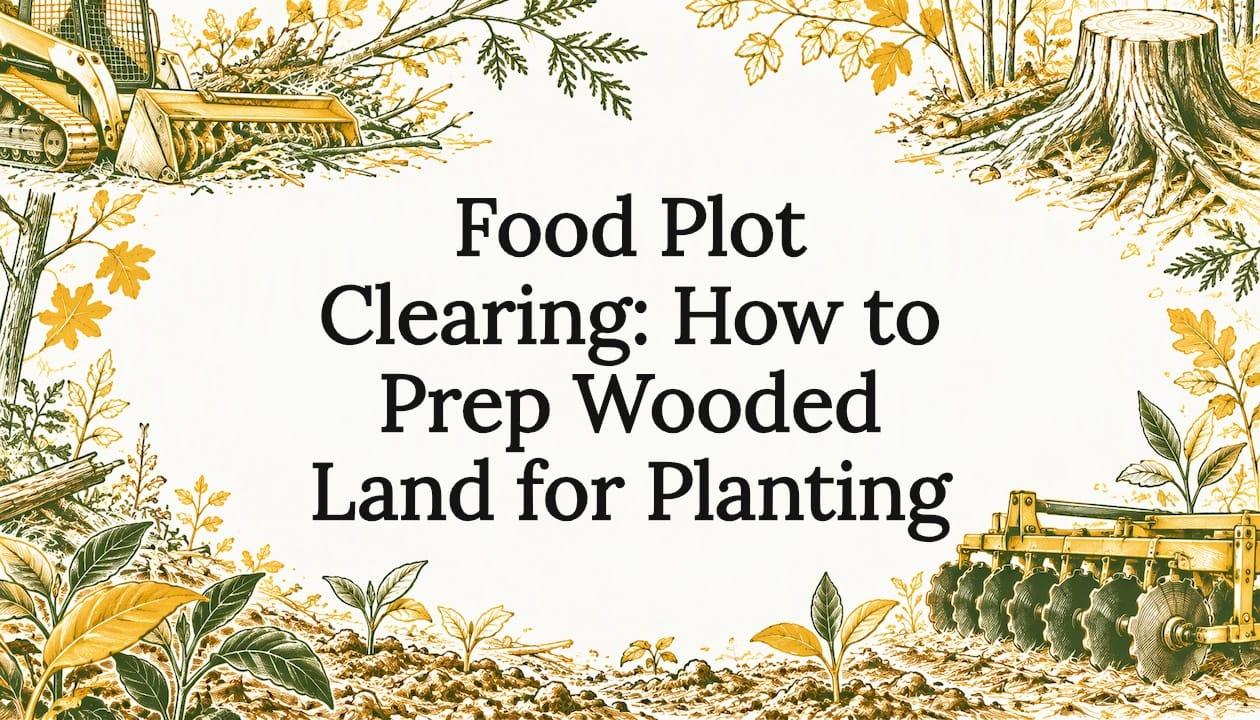
The best way to clear a food plot depends on what is standing on the ground. Brush and stems under 4 inches can be mulched or chopped in place. Bigger timber needs shearing or heavy machinery. Stumps need grinding or time. Whatever you choose, protect the topsoil, because the plot will only be as good as the dirt you leave behind. Below is how to size up the site, choose a method, deal with stumps and debris, and get the cleared ground ready to plant.
TL;DR
- Pick the spot before you clear it. Food, water and cover matter, and so do soil, slope and wind direction.
- Match the method to stem size: mulching handles brush and stems up to about 6 to 8 inches, while larger timber calls for shearing or a dozer.
- Dozers clear fast but often strip topsoil. Mulching keeps it in place.
- Grind stumps 8 to 12 inches deep, or cut them low and till around them if the plot is small and the budget is tight.
- Run a soil test (about $15 per sample) before you buy lime and fertilizer.
Table of Contents
- Choose the right spot before you touch a tree
- Match the clearing method to what is standing
- Stumps, roots and leftover wood
- Clearing a food plot on a budget
- Prepare the cleared ground for planting
- A realistic order of operations
- Have us clear your plot
- FAQ
- Sources
Choose the right spot before you touch a tree
Clearing is the most expensive step in a food plot. Clearing the wrong place wastes all of it.
Oklahoma State Extension advises placing food plots in areas the target species already uses, near suitable cover and upwind of the usual wind direction from where you will hunt or watch. It also says to avoid infertile, rocky or wet soils and slopes steeper than 7 percent. A plot on a steep, soggy bench will fight you every season.
The Missouri Department of Conservation frames habitat around food, water and cover. Walk the property and note where the trees, shrubs and grass sit, where water is, and where cover already exists. Purdue Extension adds that a plan should weigh your goals, the existing habitat, property size, the species present and what the neighbors' land offers. If the neighbor's property is a thick bedding area, a plot on your side of the line may need little more than an opening.
A simple walk-through works well:
- Mark candidate openings on a map or phone, then walk each one.
- Note stem sizes, species mix, rocks, standing water and the grade.
- Pull a soil sample in each candidate spot.
- Check access. Can a truck, a trailer and a tractor reach it? A plot you cannot reach with equipment is a plot you will not maintain.
- Check your property lines and any utility or road right-of-way before any machine starts.
If some of the work is next to a fence line or boundary, our fence line and property line clearing is built for exactly that kind of narrow, precise job.
Match the clearing method to what is standing
The single most useful question is how big the stems are. Stem diameter decides which machine does the job well.
| What you are clearing | Method that fits | What to know |
|---|---|---|
| Small brush, saplings, vines | Forestry mulching, brush cutter, bush hogging | Leaves a mulch layer on the ground, little soil disturbance |
| Dense small-diameter brush under 4 inches | Drum chopping | Effective where competition is dense but small; the operator should match machine size to the stand to limit soil damage |
| Stems up to roughly 6 to 8 inches | Mulching head on a carrier machine | Can push down and mulch stems this size and grind many stump sizes |
| Many stems over 4 inches | Shearing or KG blading | Best for removing large numbers of stems above 4 inches |
| Mature timber | Dozer with grapple, or timber harvest first | Fast, but heavier on the soil |
| Small plot, tight access, fragile soil | Lopping with chainsaws and hand tools | Fells stems where they stand with little soil disturbance |
Brush and small trees
For overgrown fields, fence rows, thickets and young regrowth, mulching is usually the cleanest path. A mulching head shreds the vegetation in one pass and leaves it on the ground. No piles to burn, nothing to haul. That is the approach we use, and it fits plots carved out of honeysuckle tangles, cedar thickets and grown-over pasture. If bush honeysuckle has taken over the understory, our honeysuckle removal service clears it so the plot is not reinvaded next spring.
Larger timber
Timber is a different job. One hobbyist write-up of a 1-acre mature-forest plot reports 8 hours of dozer and grapple time on 20-year-old trees, and says younger trees are easier and older ones harder. That is one site, not a rule, but it shows how fast the hours climb as trees get bigger.
If the trees have market value, talk to a forester about a harvest first. The USDA's land clearing standard says that when a salvage harvest happens before clearing, stumps should be left higher than 1 foot to make the final clearing and grubbing easier. It also says to schedule clearing so insect or disease populations do not build up in stacked trees and stumps.
A note on heavy equipment and topsoil
Virginia Cooperative Extension is blunt about it: bulldozers and front-end loaders make for quick clearing but nearly always destroy topsoil, because ripping roots out of the ground takes soil with them. An excavator with a root rake disturbs less but does not eliminate the loss. In places with only a few inches of topsoil to begin with, that makes it much harder to establish grass or forage.
For a food plot, topsoil is the whole product. Plants carry nutrients from the soil to the animals, and Oklahoma State Extension stresses that if the soil lacks nutrients, the plants do poorly and the animals get little benefit. Choose the least disruptive method that does the job.
Stumps, roots and leftover wood
Stumps are where many plots stall. You have four realistic options.

Grind them. South Dakota State University Extension calls hiring a service to grind the stump the most effective approach, usually to a depth of 8 to 12 inches including surface roots, and notes that grinders typically charge by the inch across the longest dimension. Iowa State Extension agrees that a grinder is the quickest, easiest and safest route, with the stump gone in hours. Our stump grinding crews do this on residential and rural lots. For lawn work, our guide to stump grinding depth explains what to ask for in a quote, and what to do after stump grinding covers cleanup, fill and replanting.
Let them rot. Natural decay is cheap, but Iowa State says it can take 10 or more years depending on moisture, fungi and species. Virginia Extension reports that pine stumps, other than shortleaf pine, rot in three to five years, while hardwoods range from a few years to decades. For a small plot you can cut stumps low and till around them for a season or two, then grind later.
Treat hardwood stumps so they do not resprout. Virginia Extension notes that appropriately labeled herbicide applied to freshly cut stumps (within 15 minutes for water-based products, up to an hour for oil-based ones) is absorbed and moves to the roots, killing hardwoods that would otherwise sprout hard. Follow the product label and your state's rules.
Leave some where they are. University of Minnesota Extension advises keeping stumps and roots after harvest unless forest health requires removal, since they break down and help maintain soil nutrient balance. That makes sense on the edges of a plot. In the planting zone itself, stumps get in the way of tillage and seeding.
Where the debris goes
Cut wood has to go somewhere. The USDA standard says not to dispose of debris in standing or green timber, to place piles at least 100 feet from adjacent woodland, buildings or roads, and to keep them out of channels where flooding could carry them off. Mulching sidesteps most of this, because the material is shredded and spread in place instead of stacked. Check local rules before any open burning.
What we tell landowners about food plot clearing
Most people call us after the same discovery: the clearing was supposed to be the easy part, and it ate the budget and the weekend. A food plot is a small project with a big first step.
Our approach is one-pass forestry mulching. We grind brush and small trees into mulch right where they stand, so there is nothing to burn and nothing to haul. The ground stays covered and the topsoil stays put, which is what you need when you plan to plant in it. We handle jobs of any size, so a half-acre opening and a multi-acre plot get the same attention.
Our advice is to decide where the plot goes, tell us what is standing there, and let us quote it. Brush, honeysuckle, cedar, fence rows and stumps are the work we do every week around the Ohio, Kentucky and Indiana tri-state area.
Yoshua
Clearing a food plot on a budget
There is no honest way to make clearing free, but you can shrink the bill.
NC State Extension puts site preparation costs from $45 per acre for burning to over $200 per acre for mechanical methods in its forestry guidance. Those are forestry figures and are not what a contractor will charge you today, so treat them as a sense of the range, not a quote. Virginia Extension cites a 2008 research project in which mulching cost $850 per acre against $1,650 per acre for conventional clearing, with mulching fees running $200 to $400 per hour and sometimes much higher. Again, those are older numbers from one region. For current local pricing, see our breakdown of 2026 land clearing costs per acre and our guide to forestry mulching cost.
Ways to keep the cost down without cutting corners:
- Make the plot smaller. Many plots work well at a fraction of an acre. Clear and plant a modest opening well rather than a big one poorly.
- Choose the site for easy clearing. Old fields, logging landings, utility cuts and thin brush cost far less to open than mature hardwoods.
- Do the light work yourself. Lopping with chainsaws and hand tools suits small plots, fragile soils, steep ground and tracts too small for heavy equipment, and it disturbs little soil.
- Hire the heavy part only. Cut saplings yourself and bring in a contractor for the mulching, grinding and any big stems.
- Split the job over seasons. Clear the plot this year, grind or treat stumps next.
On financing: if you want the whole plot done at once, we offer flexible financing options for larger jobs.
Prepare the cleared ground for planting
Clearing is not the finish line. Seed on raw, unamended ground is the second most common way a plot fails.
Test the soil. Oklahoma State Extension says soil analysis is relatively inexpensive, around $15 per sample, and tells you what fertilizer and lime you need. Mississippi State Extension reports that forages planted where soil pH is below 6.0 underperform because they cannot use the nutrients available. Freshly cleared woodland soil is often acidic, so expect lime to be part of the plan. The 1-acre forest plot mentioned above needed a ton of lime and 500 pounds of 19-19-19 fertilizer, with more likely the next year. Your soil test, not another person's numbers, sets your own.
Work the soil. Oklahoma State describes conventional tillage as disking to about 6 inches. Mississippi State advises tilling or disking a few weeks before planting so turned-under thatch and roots can decompose, then rolling with a cultipacker for a firm seedbed.

Match equipment to plot size. Ohio State Extension notes that small plots can be installed with limited equipment. A medium-to-large ATV can work if you have no tractor, but most ATVs are not built to tow heavy tillage tools. A light disk may not break hard soil or sod, and small plows turn over about 6 to 8 inches of soil. If your ground has sod or old mulch, plan for a plow or a rented tractor.
A mulched surface helps here. The shredded wood sits on top and breaks down over time, and you can till it under or work around it depending on your seeding method. If you want a bare seedbed fast, ask your contractor how deep the mulch layer will be before the job starts.
A realistic order of operations
- Scout and mark the plot in late summer or fall, when the property is easy to walk and you can see what is there.
- Pull soil samples and send them in.
- Remove any timber worth selling with a forester or logger, leaving stumps at the height they recommend.
- Mulch or clear the brush and small trees.
- Grind or treat stumps in the planting zone.
- Apply lime per the soil test and work it in.
- Till or disk, then firm the seedbed with a cultipacker.
- Seed at the right time for your region and chosen planting.
Do not rush steps 6 and 7. Lime needs time to change the soil, and mulched ground needs time to settle.
Have us clear your plot
We clear land for food plots across the Cincinnati area and the wider Ohio, Kentucky and Indiana tri-state region. Our forestry mulching turns brush and small trees into mulch in one pass, with no burning and no hauling. We also handle land clearing, stumps, honeysuckle and bush hogging for fields.
Want a number before you commit? Use our instant pricing calculator to size up your project, or see everything we do on our services page.
FAQ
How big should a food plot be?
There is no single right size. Small plots are workable, and Ohio State Extension notes that small plots can be installed with limited equipment. Start with the size you can clear, lime, till and seed properly, then expand later. A well-managed small plot beats a big weedy one.
Do I need a bulldozer to clear land for a food plot?
Usually not. Mulching handles brush and stems up to roughly 6 to 8 inches, and shearing is the better fit for many stems over 4 inches. Dozers make sense for mature timber, but they often take topsoil with them. Ask any contractor how they will protect the topsoil.
Should I grind the stumps or leave them?
Grind the ones in the planting area, usually to 8 to 12 inches. Stumps on the edges can stay and rot, which also keeps some wildlife cover. If the budget is tight, cut them low, till around them, and grind later.
How long does it take to clear a food plot?
It depends on stem size, density and access. Brush and small trees can be mulched far faster than mature timber, which can take many machine hours per acre. A site visit or our instant pricing tool gives a better estimate for your property than any general rule.
When should I clear land for a food plot?
Clear well before planting, so lime has time to work and thatch has time to break down. Mississippi State Extension suggests tilling a few weeks before planting. Late summer through fall clearing gives you time to test soil and amend it before your planting window.
Sources
- Food Plots (Oklahoma State Extension, E-1032)
- Evaluating Your Land's Habitat Potential (Missouri Department of Conservation)
- Assessing Your Land's Potential (Purdue Extension)
- Site Preparation Methods and Contracts (NC State Extension)
- Options for Clearing Land to Establish Pasture (Virginia Cooperative Extension)
- Conservation Practice Standard Land Clearing, Code 460 (USDA NRCS)
- Transforming mature forest into a food plot (DeerBuilder)
- How to Remove a Stump (South Dakota State University Extension)
- How to Remove Tree Stumps (Iowa State University Extension)
- Managing forests to sustain soil biodiversity (University of Minnesota Extension)
- A Cost-Production Comparison of Common Food Plot Plantings (Mississippi State Extension, P3604)
- Wildlife Food Plots Equipment and Installation (Ohio State University Extension)