
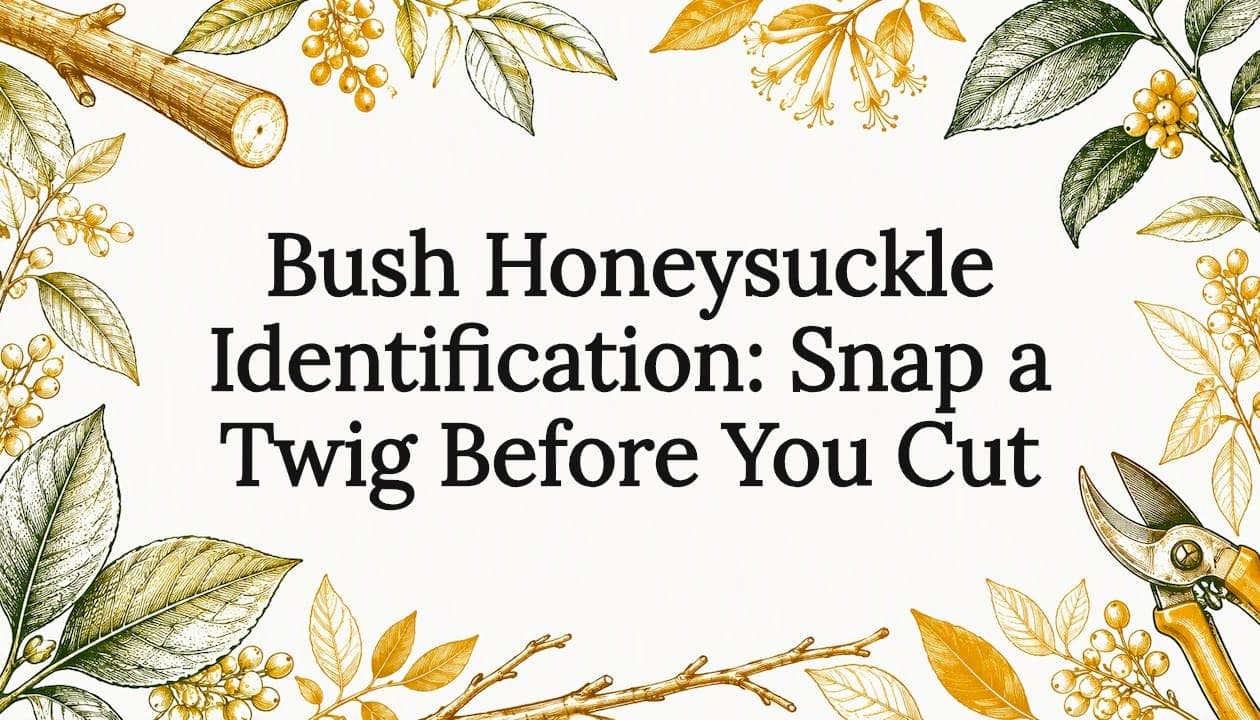
If your shrub has opposite leaves and a hollow brown center when you snap a twig, it is almost certainly invasive bush honeysuckle. That twig test is the fastest field check, and it works on young and old plants alike. Mature plants commonly stand 6 to 20 feet tall. Photograph the leaves, flowers or berries, and a broken twig, then confirm below.
TL;DR:
- Native lookalikes often have toothed leaves and solid pith, so leave uncertain plants untouched and send dated photos to your local extension office for confirmation.
- Mature shrubs commonly reach 6 to 20 feet, and dense thickets may require equipment; hand pulling suits only small, young seedlings.
- Established shrubs can resprout unless the stump is treated immediately after cutting, so prepare the treatment before you cut.
- Foliar herbicide applications are often most effective in October, after native plants go dormant; follow the label and check local rules before spraying.
- Seeds can remain viable in soil for up to five years, so inspect treated areas for new growth over several years after removal.
Table of Contents
- What does bush honeysuckle look like up close?
- How do you tell it apart from lookalikes?
- When and where are you most likely to spot it?
- What are your removal options, and what results can you expect?
- What is the expert checklist for a confident ID?
- Which other invasive shrubs get mistaken for it?
- Why does correct identification matter for local ecosystems?
- My take: identify first, then choose your effort
- Need a hand clearing a honeysuckle thicket?
- FAQ
- Sources
What does bush honeysuckle look like up close?
Match your shrub against the traits Penn State Extension lists for invasive shrub honeysuckles:
- Leaves: opposite each other on the stem, oval to elliptical, about 1–3 inches long, with smooth edges.
- Habit: several stems rising from one base, forming dense thickets.
- Stems: grayish-brown, with striated bark on older stems and a hollow brown pith between the nodes.
- Spring flowers: paired, tubular blossoms that open white or pink and often fade to yellow between April and June.
- Fruit: paired, round red or orange berries, ripening by late summer.
Mature plants reach 6 to 20 feet, with leaves of about 1 to 3 inches. That range comes from the same extension guidance, and it explains why a leggy hedge you ignored for years can suddenly tower over a fence.
Several species share these traits. Amur, Morrow and Tatarian honeysuckle are the most common invasive ones, and Illinois Extension notes that Amur can reach about 20 feet while "bella" hybrids stay shorter. Park Service botanists point out that the group is often treated together for management because telling species apart is hard. For a homeowner, group-level identification is enough.
Take several photos before you decide anything: the underside of a leaf, a twig cut across, and any flowers or fruit. Together they make a far stronger case than one blurry shot.
How do you tell it apart from lookalikes?
Native shrubs and vines can resemble bush honeysuckle at a glance, and pulling the wrong plant helps nobody. Penn State's guidance calls the broken twig the most reliable way to separate invasive bush honeysuckle from native shrubs. Invasive stems are hollow and brown inside, while native lookalikes have a solid center.
Leaf edges give a second clue. Invasive bush honeysuckles usually have smooth margins, and many native lookalikes have toothed ones. Growth form helps too. Japanese honeysuckle is a vine, unlike the upright, multi-stemmed shrub form described here. Berry color and arrangement can help distinguish other shrubs from the paired red or orange fruit described here.
Run this quick check before you cut anything:
- Confirm the leaves sit opposite each other, not staggered along the stem.
- Check that the leaf edges are smooth rather than toothed.
- Snap a twig and look for a hollow brown center rather than a solid one.
Pro Tip: Snap twigs from three or four different stems on the same plant. One odd sample can mislead you, but a consistent result across stems is trustworthy.
When and where are you most likely to spot it?
Timing is your best ally. Invasive bush honeysuckle is typically the first to leaf out in spring and the last to drop leaves in fall, so a green shrub in a bare winter woodland is a prime suspect.
- Habitats: forest edges, openings, roadsides, abandoned fields, fencerows, stream edges and other disturbed ground.
- Spread: birds eat the berries and carry seeds along roads and waterways.
- Seed bank: seeds can stay viable in soil for several years, so check bare patches near known plants.
What are your removal options, and what results can you expect?
Match the method to the size of the plant and the size of the infestation.
- Seedlings: hand-pull them when the soil is moist, then bag them so they cannot reseed. University of Minnesota Extension says hand-pulling suits only small, young plants.
- Established shrubs: cut the plant, then apply a systemic herbicide such as glyphosate or triclopyr to the stump right away. Waiting lets the cut surface seal, and the roots resprout.
- Foliar spraying: often most effective in October, once native plants have gone dormant.
- Forestry mulching: a machine grinds the shrubs into mulch on site in one pass, with no burning and no hauling. The realistic limit is that roots remain, so regrowth still needs follow-up.
- Monitoring: plan on checking for new growth for several years. Minnesota's extension specialists note seeds can persist in the soil for up to five years.
Read product labels closely, and ask your state extension office about local herbicide rules before you spray. Our own write-up on low-waste honeysuckle removal compares solarizing, cutting and mulching in more detail.
Pro Tip: Cut and treat the stump on the same day, with your herbicide already mixed and in the truck, so no cut surface sits untreated.
If you hire help for hauling debris after a manual cleanup, a service such as Ohana Property Services handles debris removal and yard waste for Central Indiana properties.
What is the expert checklist for a confident ID?
Extension guidance boils down to a short checklist:
- Leaves grow opposite each other along the stem.
- Leaves are roughly 1–3 inches long with smooth edges.
- The plant grows as a multi-stemmed shrub.
- Older stems have grayish-brown, striated bark.
- A snapped twig shows a hollow brown pith.
- Flowers are paired and tubular, or berries are paired and red or orange.
The pith test decides close calls because it does not depend on season or plant age. Penn State frames it this way:
The most reliable way to distinguish invasive bush honeysuckle from native shrubs is to break a twig: invasive species have a hollow, brown pith while native lookalikes have a solid center.
Photograph the leaves, a twig cross-section, and any flowers or fruit. Note the date and location so you can report the plant to a local invasive species program or share it with a contractor for a quote.
Which other invasive shrubs get mistaken for it?
Honeysuckle is not the only invader in a woodland edge, and a few others are commonly confused with it, which is why checking features beats guessing by shape.
Other shrubs can be mistaken for bush honeysuckle, so compare their features with the paired red or orange fruit described here. Some honeysuckle species have a vine growth form, unlike the upright shrubs described above.
Native lookalikes complicate things further. Some native shrubs carry opposite leaves and similar-looking fruit, which is exactly why leaf edges and the twig test matter. Toothed margins and a solid pith point toward a native plant that you should leave alone.
A practical habit helps here: compare features rather than overall impressions. Overall shape changes with sun, pruning and age, while the pith, the leaf arrangement and the margin stay constant. When one feature disagrees with the rest, treat the plant as unconfirmed and gather more evidence.
Local extension offices are the best arbiters for edge cases. Send your dated photos and a description of the twig test, and ask them to confirm before you commit to cutting or spraying. A short email can save you a season of work on the wrong plant.

Why does correct identification matter for local ecosystems?
Misidentification has real costs because the plant does real damage. University of Maryland Extension notes that invasive bush honeysuckles form dense thickets that displace native biodiversity and can produce chemicals that inhibit nearby native plants. Property owners often mistake them for natives, so the problem grows unnoticed.
These shrubs were introduced as ornamentals and for erosion control. According to another Maryland Extension page, they now occupy edges, hedgerows and disturbed habitats across the eastern and central U.S. and often outcompete native early-season plants.
That early leaf-out matters ecologically. Dense thickets can reduce native biodiversity and inhibit nearby native plants. Left alone, a few shrubs along a fence can become an understory that little else can grow beneath.
Accurate identification protects you in both directions. It keeps you from removing a harmless native, and it helps you catch a real infestation while it is still small enough to manage by hand.
My take: identify first, then choose your effort
I think most people lose time at the identification step, not at the removal step. They either ignore a plant that is spreading or tear out a native one that was doing fine. Break the twig, photograph it, and ask your local extension office before any large treatment.
Small plants may be manageable by hand. Dense thickets need equipment and a plan, and that is where hiring professionals tends to pay for itself.
— Yoshua
Need a hand clearing a honeysuckle thicket?
When a thicket is dense or your time is short, we clear it for you. Our forestry mulching service grinds shrubs into mulch on site in one pass, with no burning and no hauling. For a broader scope, see our brush removal work.
Ask any contractor for the scope, whether they mulch in one pass, the disposal plan, and pricing or financing options. Before you call, photograph the site and note access limits such as gates or slopes. Then get an instant quote from us, and we will take it from there.
FAQ
Is honeysuckle toxic to dogs?
Honeysuckle is not listed on the ASPCA toxic plants list. Eating any plant material can still upset a pet's stomach, so call your vet or the ASPCA Poison Control hotline at (888) 426-4435 if your dog chews on it.
How can you tell native honeysuckle from invasive honeysuckle?
Snap a twig. Invasive bush honeysuckle has a hollow brown center, while native lookalikes have a solid one. Smooth leaf edges also point toward the invasive group, since many natives have toothed margins.
How long do honeysuckle bushes last?
Established shrubs can persist for many years and resprout from their roots after cutting, which is why stump treatment matters. Seeds can stay viable in the soil for up to five years, so plan to monitor the site for several years.
What is the best time to treat bush honeysuckle with herbicide?
Foliar applications are often most effective in October, after native plants go dormant. Stump treatments work best applied immediately after cutting, and you should always follow the product label.